

A professionally installed vinyl fence typically runs $15 to $95 per linear foot, with most homeowners landing between $2,292 and $5,799 for a complete job, according to BobVila’s cost guide. The national average sits around $4,045. That wide spread exists because a 4-foot picket fence and a 6-foot privacy fence are completely different products, even though both are “vinyl.”
Use this formula to build your own estimate before you call a single contractor:
What the per-foot range covers:
- Vinyl panels and posts (standard grade)
- Concrete for post footings
- Labor for layout, digging, setting, and panel installation
- Basic site cleanup
It does NOT automatically include gates, permit fees, old fence removal, or delivery surcharges. Those line items are where budgets quietly expand.
Key Takeaways
Installed vinyl fence cost runs $15–$95 per linear foot depending on style and height, with most complete residential projects landing between $2,292 and $5,799 before gates, permits, and contingency.
| Point | Details |
|---|---|
| Typical installed range | Most projects fall between $2,292 and $5,799; national average is around $4,045. |
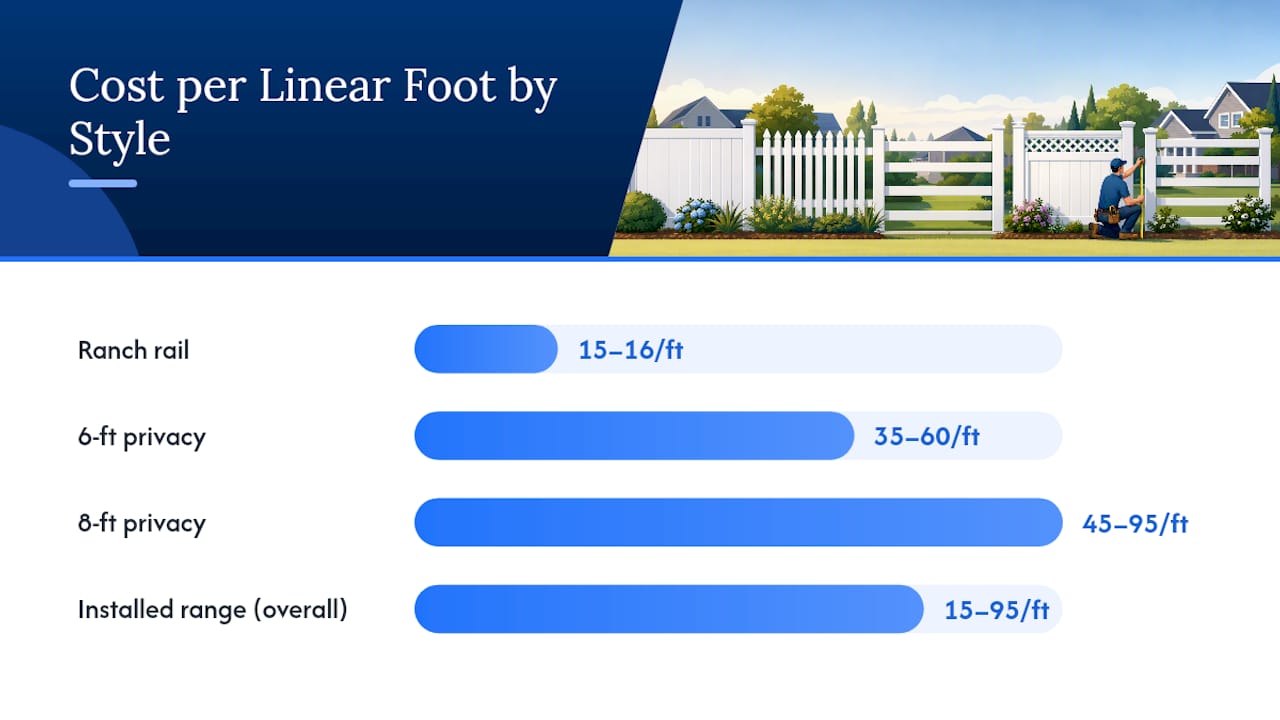
| Per-foot by style | Ranch rail runs $16–—/ft; 6-ft privacy runs $35–$60/ft; 8-ft privacy runs $45–$95/ft. |
| Budget formula | Multiply linear feet by cost per foot, then add gates, permits, demo, and 10–20% contingency. |
| Gates add significant cost | One walk gate adds $300–$600; a double driveway gate adds $800–$2,000+ to the total. |
| Permits and specs in writing | Check local permit requirements before starting; get panel width and post depth on the contract. |
| Advantagefencenj | Provides full-service vinyl fence installation with itemized quotes, permit support, and warranty coverage. |
Table of Contents
- What does vinyl fence cost per linear foot by style?
- What site conditions change your final price?
- How much do gates and add-ons cost?
- Sample budgets: how to estimate your total cost
- How does vinyl fence cost compare to wood, chain link, and aluminum?
- What does the installation timeline look like?
- What should you ask contractors before signing?
- What are the ongoing maintenance costs and lifespan of vinyl fencing?
- What installers see that homeowners miss
- Advantage Fencing handles the full project, from survey to final inspection
- Sources
What does vinyl fence cost per linear foot by style?
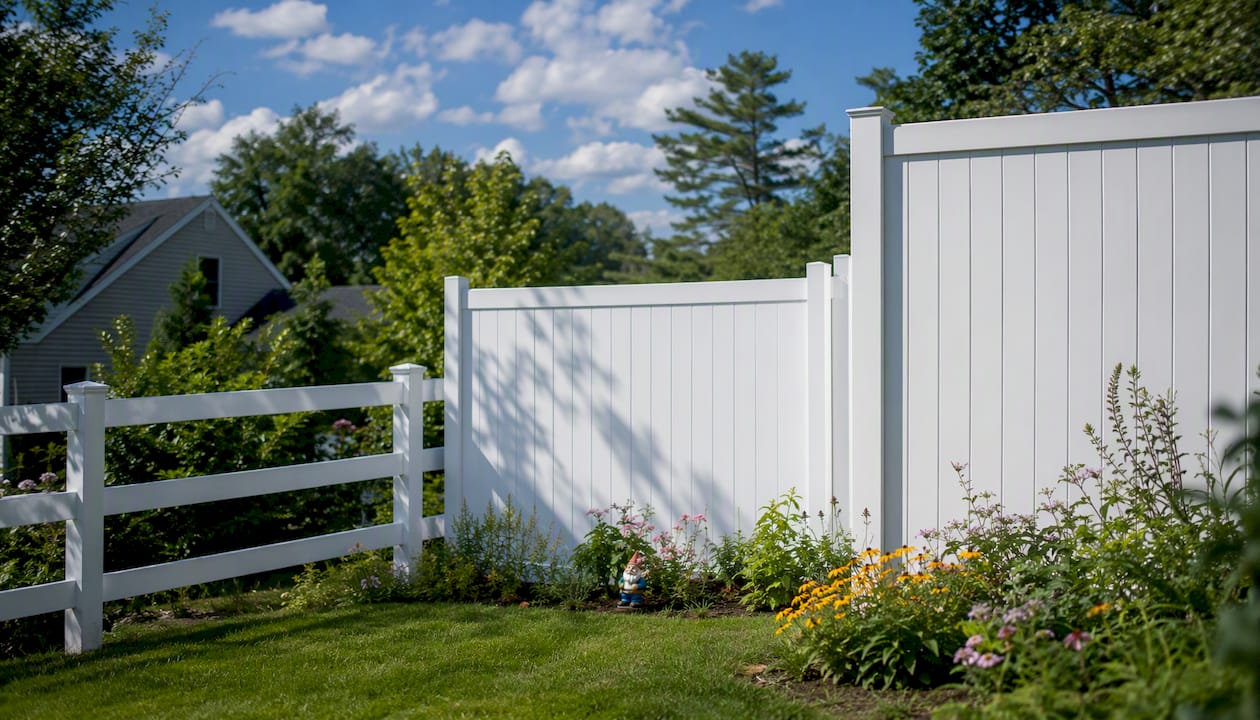
The style and height you choose move the needle more than almost any other factor. A 3-rail ranch fence uses far less material than a solid 6-foot privacy panel, and that difference shows up directly in the per-foot price.
Contractor benchmarks from Visual Fence Pro and LatestCost’s 2026 pricing guide put the installed ranges like this:
The 8-foot privacy column deserves a closer look. At $45–$95 per foot installed, vinyl privacy fence pricing reflects not just more material but often taller posts, deeper footings, and in some jurisdictions, a structural review. An 8-foot fence can trigger wind-load calculations or a different permit classification entirely, which adds both cost and time.
A few things shift where you land within any given range:
- Panel width: Narrower panels (6 ft vs. 8 ft) increase the number of posts and the amount of concrete, raising per-foot cost even when the panel price looks similar.
- Vinyl grade: Thicker-wall vinyl (0.150" vs. 0.100" wall thickness) costs more upfront but resists impact and UV degradation far better over time.
- Post spacing: Tighter post spacing for windy sites or heavy gates adds material and labor.
What site conditions change your final price?
The per-foot number a contractor quotes assumes a reasonably flat, accessible yard with normal soil. Most yards are not that. HUD’s sitework cost guidance confirms that grading, excavation, and soil conditions are among the most common sources of construction cost overruns, and fence projects are no exception.
Here are the factors that most often push a quote higher:
- Rocky or clay soil: Digging post holes in rock or dense clay requires power equipment. Expect a surcharge of $5–$15 per post, sometimes more.
- Sloped yards: A fence on a grade either steps (stair-steps down the slope) or rakes (follows the slope continuously). Both require more labor and planning than a flat run.
- Limited access: If a crew can’t get equipment through a gate or along a side yard, every post hole gets dug by hand. That adds hours.
- Frost depth: In colder climates, posts must extend below the frost line, often 36–48 inches deep. Deeper holes mean more digging and more concrete per post.
- Utility locates: Before any post goes in, utilities must be marked (call 811). If lines run through your fence path, the crew may need to hand-dig or reroute, which adds time.
- Existing fence removal: Demo and disposal typically adds $3–$8 per linear foot, depending on the old material and how accessible the site is.
The CalcEXP vinyl fence estimator breaks down exactly how post depth, concrete volume, and labor surcharges stack up in a full estimate, which is worth running before your first contractor meeting.
Pro Tip: Ask every contractor to specify post depth, hole diameter, and concrete bags per post in writing. Two bids at the same per-foot price can represent very different installations if one uses 24-inch posts and the other uses 48-inch posts.
Treat that buffer as a fixed line item, not an afterthought. Projects that skip it are the ones that stall when the crew hits a buried concrete pad or a utility line mid-run.
How much do gates and add-ons cost?
Gates are priced separately from the fence run for a straightforward reason: they require heavier posts, more hardware, and more labor than a standard panel. A gate post typically needs to be set deeper and braced differently to handle the swing weight over years of use.
Common gate and add-on price ranges:
- Single pedestrian walk gate (3–4 ft wide): $150–$400 for the gate itself; installed total often $300–$600 including reinforced posts and hardware
- Double driveway gate (10–16 ft wide): $800–$2,000+ installed, depending on width and whether it’s manual or automated
- Gate post upgrade (reinforced, larger diameter): $50–$150 per post above standard post pricing
- Decorative post caps: $10–$40 per cap; a 100-foot run might use 12–15 posts
- Lattice top panels: $5–$15 per linear foot added to the base panel price
- Puppy picket or small-gap inserts: $3–$8 per linear foot added
To see how this plays out on a real budget: a 100-foot privacy fence at $47/ft comes to $4,700 before gates. That’s the gap that catches homeowners off guard when they compare a fence-only quote to a complete project quote.
Sample budgets: how to estimate your total cost
The estimation formula is simple to apply once you have your measurements. Walk the perimeter you want to fence, note the linear footage, count the gate openings, and then plug in the numbers.
What to include in a complete budget:
- Materials and labor (linear feet × per-foot rate)
- Gate(s), including reinforced posts and hardware
- Permit fees (varies by municipality; often $50–$200 for residential fences)
- Demolition and disposal of existing fence (if applicable)
- Delivery surcharges for rural or difficult-access sites
- 10–20% contingency
Here are three sample budgets using the typical per-foot range for a 6-foot privacy fence ($35–$60/ft installed), one walk gate, and a standard permit:
1. 100-foot privacy fence
- Low: 100 ft × $35 = $3,500 + $350 gate + $100 permit + $395 contingency (10%) = ~$4,345
- Typical: 100 ft × $47 = $4,700 + $450 gate + $125 permit + $528 contingency = ~$5,803
- High: 100 ft × $60 = $6,000 + $600 gate + $150 permit + $675 contingency = ~$7,425
2. 150-foot privacy fence
- Low: 150 ft × $35 = $5,250 + $350 gate + $100 permit + $570 contingency = ~$6,270
- Typical: 150 ft × $47 = $7,050 + $450 gate + $125 permit + $763 contingency = ~$8,388
- High: 150 ft × $60 = $9,000 + $600 gate + $150 permit + $975 contingency = ~$10,725
A 150-foot vinyl privacy project can realistically fall anywhere from the mid-$6,000s to over $14,000 when site conditions, gate count, and material grade are factored in.
3. 200-foot privacy fence
- Low: 200 ft × $35 = $7,000 + $700 (two gates) + $150 permit + $785 contingency = ~$8,635
- Typical: 200 ft × $47 = $9,400 + $900 (two gates) + $150 permit + $1,045 contingency = ~$11,495
- High: 200 ft × $60 = $12,000 + $1,200 (two gates) + $200 permit + $1,340 contingency = ~$14,740
When you receive a contractor’s per-foot quote, verify what it includes. Ask specifically: Does this include gate posts? Permit fees? Disposal of my old fence? If any of those are excluded, add them back before comparing bids.
How does vinyl fence cost compare to wood, chain link, and aluminum?
Vinyl sits in the middle of the material cost spectrum. It costs more upfront than chain link and wood, but its maintenance profile changes the long-term math significantly. The comparison below uses generic installed cost ranges; no single contractor’s pricing will match exactly, and regional labor rates from BLS data can shift these numbers by 20–30% depending on your market.
For a deeper look at aluminum pricing, the aluminum fence cost guide breaks down installed ranges by style and height in the same format as this article.
A few tradeoffs worth spelling out:
Wood:
- Lower upfront cost, but staining or sealing every two to three years adds $200–$600 per treatment for a typical backyard run
- Susceptible to rot, insect damage, and warping; replacement sections are common after 10 years
Chain link:
- The cheapest option by a wide margin, but offers no privacy and limited curb appeal
- Galvanized versions hold up well; vinyl-coated versions add cost but improve appearance
Vinyl:
- No painting, staining, or sealing required; a pressure wash once a year keeps it looking new
- UV-stabilized grades resist fading for decades; cheaper grades can yellow or become brittle
Aluminum:
- Strong for decorative and pool-code applications; won’t rust
- Not a privacy solution without added screening; costs overlap significantly with vinyl
The long-term cost of ownership often favors vinyl over wood when you factor in 20 years of maintenance. A wood fence that costs $1,500 less upfront can easily cost $3,000–$5,000 more over its lifetime in treatments and partial replacements.
What does the installation timeline look like?
A typical residential vinyl fence project moves through six stages. The total calendar time from first call to finished fence is usually three to eight weeks, though that range stretches in busy seasons or when permits take longer than expected.
- Site survey and quote (1–3 days): A contractor walks the property, measures, identifies utility conflicts, and notes slope or access issues. You receive a written bid.
- Permit and HOA approval (1–3 weeks): Many municipalities require a permit for fences above a certain height, often 6 feet. Seattle’s permit guidance illustrates how local rules vary; Portland’s residential permitting process shows a similar checklist approach. HOA review can run parallel but sometimes adds another week.
- Material lead time (1–2 weeks): Vinyl panels are typically ordered after permit approval. Custom colors or non-standard sizes can extend this.
- Demolition (half a day to 1 day): If an existing fence needs to come down, most crews handle this the morning of installation or the day before.
- Post setting (1 day): Posts go in first, set in concrete. Crews typically wait 24–48 hours for concrete to cure before hanging panels.
- Panel and gate installation (1–2 days): Panels snap or screw into posts; gates are hung, leveled, and hardware is adjusted.
A few things extend timelines beyond this baseline:
- Spring and early summer are peak season; lead times for both materials and crew scheduling stretch by two to four weeks
- Wet weather delays concrete curing and can push panel installation by several days
- Rocky soil or utility conflicts discovered during post-setting can add a half-day or more
Getting a pre-installation site survey done before you finalize your quote helps surface these issues before they become schedule surprises.
What should you ask contractors before signing?
Getting three written bids is standard advice, but three bids are only useful if they cover the same scope. The most common mistake homeowners make is comparing a complete bid against a stripped-down one without realizing the difference.
Questions to ask every contractor:
- What is the panel width, and how many posts does that require for my linear footage?
- How deep will posts be set, and what diameter are the holes?
- How many bags of concrete per post?
- What vinyl wall thickness and grade are you using?
- What gate hardware brand and weight rating are included?
- Are permit fees included, or billed separately?
- Who handles utility locates, and is that cost included?
- Is old fence demolition and disposal in the quote?
- What is your warranty on materials and on labor separately?
- What is your change-order policy if site conditions differ from the quote?
- What is the payment schedule, and when is the final payment due?
Pro Tip: Ask for the panel and post specs in writing as a line item on the quote, not just verbally. Panel width directly controls post count, and a contractor using 6-foot panels instead of 8-foot panels on a 100-foot run adds two extra posts and the labor to set them. That difference rarely shows up unless you ask.
To normalize bids that aren’t apples-to-apples, add back any missing line items at market rate. If one bid excludes permit fees and another includes them, add $100–$200 to the first bid before comparing totals. The same logic applies to demolition, delivery, and gate hardware. Scope gaps, not per-foot price differences, are usually what make one bid look dramatically cheaper than another.
Scope clarity also protects you from DIY-scope-creep problems that can arise mid-project, similar to the pitfalls described in this guide on DIY project challenges.
What are the ongoing maintenance costs and lifespan of vinyl fencing?
Vinyl’s biggest selling point over wood is what you don’t have to do. No staining, no sealing, no annual painting. The maintenance list is genuinely short.
Expected maintenance tasks and costs:
- Annual pressure wash: $0 if you own a pressure washer; $75–$150 if you hire it out. Removes mildew, dirt, and pollen.
- Occasional panel repair: A cracked or broken panel section typically costs $50–$150 in materials to replace; labor adds $100–$200 depending on the contractor’s minimum.
- Gate hardware adjustment: Hinges and latches loosen over time. A basic adjustment takes 20 minutes and costs nothing; replacement hardware runs $20–$80.
- Post cap replacement: Caps blow off or crack; replacements cost $5–$20 each.
A well-installed residential vinyl fence typically lasts 20–30 years. Several factors push that number in either direction:
- UV exposure: Cheap vinyl without UV stabilizers yellows and becomes brittle within 10 years. Specify UV-stabilized material in your contract.
- Gate weight and frequency: Heavy driveway gates stress the gate post and hinge side of the panel. Reinforced posts and quality hardware extend gate life significantly.
- Installation quality: Posts set too shallow heave in freeze-thaw cycles. This is the single most common cause of early fence failure, and it’s entirely preventable with proper post depth.
- Wind load: In exposed locations, panels that aren’t properly secured to posts can rack or blow out during storms.
For context on repair costs, BobVila’s vinyl fence guide notes that minor repairs and cleaning are the primary ongoing expenses, keeping annual maintenance costs well below what wood requires.
What installers see that homeowners miss
Most homeowners who end up over budget didn’t miss the big numbers. They missed the small ones that compound.
The four surprises that show up most often on vinyl fence jobs: panel-size mismatches that inflate post counts, gate posts that weren’t reinforced because nobody specified it, a scope that didn’t define who handles permit paperwork, and permit delays that pushed the install date three weeks past the crew’s availability window. Each one is preventable at the quoting stage.
The fix is almost always the same: get the specs in writing before you sign. Panel width, post depth, concrete volume, gate hardware model, permit responsibility, and payment milestones should all be line items on the contract, not verbal assurances. A contractor who resists putting those details in writing is telling you something worth knowing before you hand over a deposit.
Advantage Fencing handles the full project, from survey to final inspection
Budgeting is one thing. Getting a fence that actually holds up, passes inspection, and looks right in five years is another. Advantagefencenj handles every stage of a vinyl fence project: on-site survey, written material takeoff, permit application assistance, professional installation with properly reinforced gate posts, and warranty-backed workmanship.

Services included with every Advantagefencenj vinyl project:
- On-site survey and accurate linear footage measurement
- Written quote with panel width, post depth, and concrete specs itemized
- Permit application support for local municipalities
- Reinforced gate post installation with quality hardware
- UV-stabilized vinyl panel selection across multiple styles and heights
- Warranty coverage on both materials and labor
Homeowners in Gloucester, Camden, Burlington, and Atlantic counties can request a free vinyl fence estimate directly from Advantagefencenj. A full-service installation quote, with every line item spelled out, is the fastest way to move from budget research to a project start date.
Sources
These are the primary sources used for cost figures, permit guidance, and estimator methodology in this article:
- How Much Does a Vinyl Fence Cost to Build? (Budget Guide) | BobVila
- Vinyl Fence Installation Guide for Contractors: Materials, Labor, and Pricing (2026) | Visual Fence Pro
- Fences (permits) | Seattle Department of Construction & Inspections
This article provides general cost information for budgeting purposes. Prices vary by location, contractor, and site conditions. Confirm permit requirements with your local municipality and get written bids from licensed contractors before starting any fence project.