

Vinyl fences come in seven main color families: white, off-white/cream, tan/khaki, light gray and charcoal, brown/wood-look, black/charcoal, and custom or bold colors. The single most useful selection rule is to match your fence color to your home’s siding and roof tones, then factor in your climate. Lighter colors hold up better under intense sun, while wood-grain and two-tone finishes add depth that flat solid colors can’t replicate. PVC vinyl fencing resists rot, insects, and splintering and comes in a range of textures that suit everything from colonial picket fences to tall privacy panels.
Three things to do before you order:
- Request physical swatches from your installer, not just screen images
- Ask specifically whether the product uses UV stabilizers
- Look at in-situ photos of the color on homes similar to yours
Pro Tip: Hold swatches against your home’s siding in both morning and afternoon light before committing. Colors shift dramatically between 8 AM shade and 2 PM direct sun.
Key Takeaways
White and tan remain the most practical, resale-friendly vinyl fence colors for most U.S. homeowners, while gray and wood-grain finishes are the fastest-growing choices for contemporary and craftsman-style properties.
| Point | Details |
|---|---|
| Match color to architecture and climate | Lighter colors suit hot, sunny climates; darker tones need wider expansion gaps and UV-stabilized PVC. |
| Test samples in-situ, not on screen | Hold physical panels against your siding in morning and afternoon light before ordering. |
| Ask about through-color vs. surface finish | Through-color PVC holds its hue deeper into the material and typically carries stronger fade warranty terms. |
| Gray and wood-grain are trending | Manufacturers report rising demand for gray tones and realistic wood-look finishes as buyers seek low-maintenance alternatives to lumber. |
| Advantagefencenj offers samples and consultation | Sample panels, in-yard mockups, and written warranty documentation are available before any material is ordered. |
Table of Contents
- 1. What vinyl fence colors are available by family?
- 2. Wood-grain finishes and two-tone options are worth understanding separately
- 3. How to use color charts and order physical samples
- 4. How to choose the right color with your installer
- 5. Current color trends shaping vinyl fence choices
- 6. Downsides, fade risk, and maintenance by color
- 7. How weather conditions affect durability across color choices
- 8. How color affects fence longevity and warranty coverage
- 9. Environmental considerations for vinyl colorants and finishes
- 10. Seeing colors in context before you commit
- What installers know that most homeowners don’t
- Advantage Fence makes color selection straightforward
- Sources
1. What vinyl fence colors are available by family?
Most standard product lines cover four to five solid families, plus a handful of wood-grain prints. Custom hues exist but carry a price premium. Here’s how each family behaves in the real world.
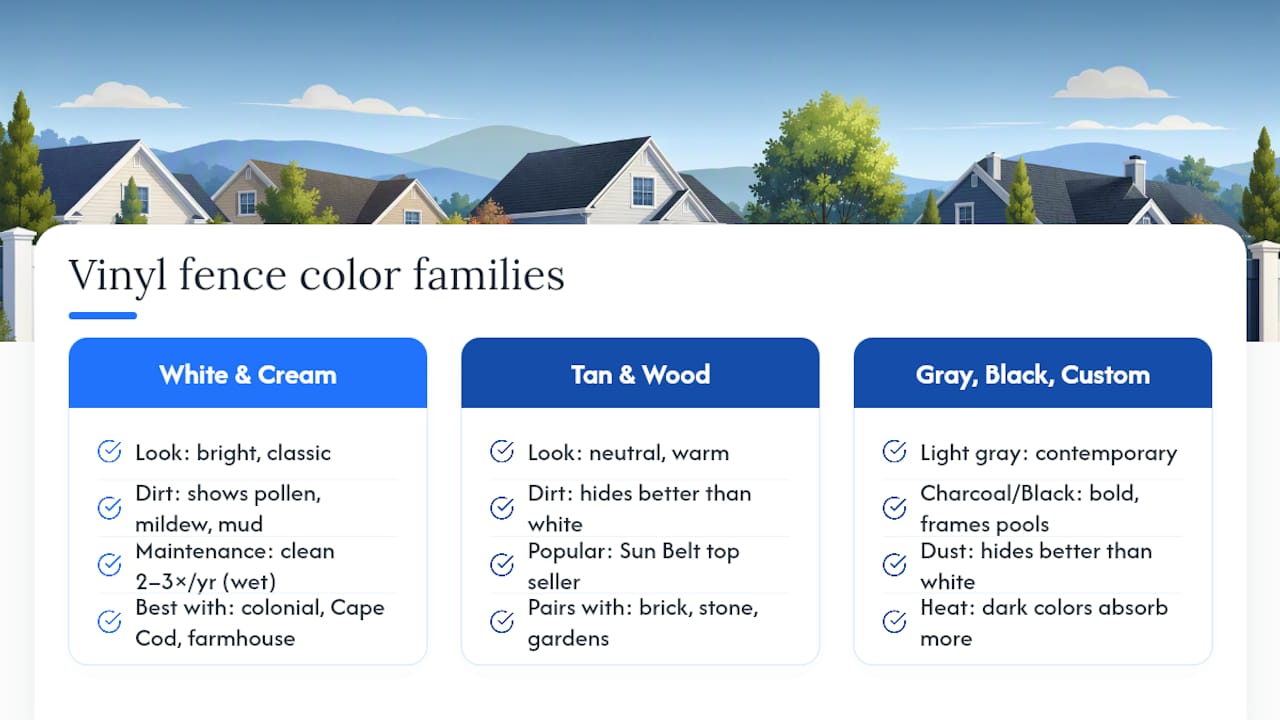
White is the most universally recognized vinyl fence color and the easiest to pair with almost any home style. It brightens a yard visually, reads as clean and classic, and suits colonial, Cape Cod, and farmhouse architecture equally well. The trade-off is dirt visibility: white shows pollen, mildew, and mud splatter more than any other shade. A garden hose and mild detergent handle most of it, but expect to clean two or three times a year in wet climates.
Off-white and cream split the difference between white’s brightness and tan’s warmth. These shades work particularly well with homes that have warm-toned brick or stone exteriors. Cream tends to read as softer and less stark in photos, which matters if you’re thinking about resale.
Tan and khaki are the go-to neutrals for Sun Belt homeowners. Tan and cream hide dirt better than pure white and pair naturally with brick and stone, making them a practical choice for properties where the fence runs close to garden beds or unpaved areas. In the Southwest and Southeast, tan is often the top-selling shade precisely because it stays presentable between cleanings.
Light gray and charcoal have moved from specialty to near-standard over the past few years. Light gray reads as contemporary and pairs cleanly with modern or transitional homes with fiber-cement siding. Charcoal is bolder, works well as a framing element around a pool or patio, and suits homes with dark trim or metal roofing. Both shades hide surface dust better than white.
Brown and wood-look tones (cedar, walnut, weathered gray-brown) are the fastest-growing segment in the premium tier. They deliver the warmth of a stained wood fence without the annual maintenance. Cedar-tone vinyl suits craftsman and rustic homes; walnut reads more formal and works with traditional brick colonials.
Black and dark charcoal are the architectural statement choice. They frame a yard the way a picture frame defines a painting, and they’re popular around pools, modern homes, and commercial properties. The practical note: dark colors absorb significantly more heat, which affects thermal expansion and long-term performance in hot climates.
Custom and bold colors exist but are typically factory-order items with longer lead times and higher costs. Sage green, navy, and deep burgundy appear in some manufacturer catalogs. Unless your home’s palette strongly calls for one, the resale math rarely favors a bold custom color.
Pro Tip: Lighter colors make a yard feel larger; darker colors make a fence recede visually and draw the eye to what’s behind it. If your yard is small, white or cream will open it up more than charcoal will.
A quick comparison of the main families:
2. Wood-grain finishes and two-tone options are worth understanding separately
Wood-grain vinyl and two-tone systems are distinct product categories, not just color choices. They affect cost, installation, and long-term performance differently than solid-color panels.
Wood-grain textures are embossed into the PVC surface during manufacturing. Entry-level wood-print products use a single repeated grain pattern, which looks noticeably artificial up close. Higher-grade wood-grain vinyl varies the color streaking and grain pattern from board to board to avoid that repetitive, stamped look. The difference in realism between a budget wood-print and a premium variegated-grain panel is significant. Common tones include cedar (warm orange-brown), walnut (darker, cooler brown), and weathered gray (driftwood aesthetic). If you’re comparing vinyl wood-look against actual wood fencing, the wood fencing page covers how the aesthetics and maintenance demands differ.
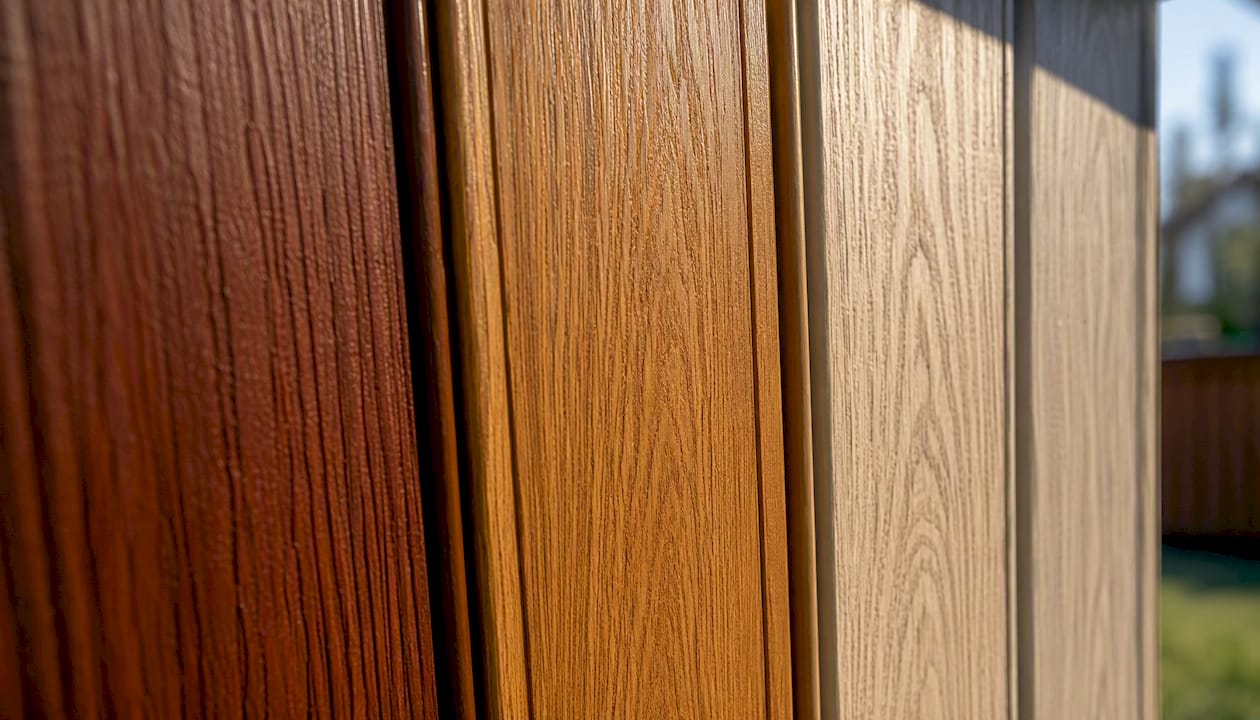
Two-tone systems use contrasting colors on different fence components. The most common approach pairs white or cream rails and posts with a wood-grain or tan picket infill, creating a trim-like effect that adds architectural definition. Some manufacturers offer the reverse: dark posts with lighter infill. The visual result is closer to a painted wood fence than a standard vinyl product.
Practical trade-offs to know before ordering:
- Premium wood-grain panels cost more than solid-color equivalents, sometimes significantly
- Darker wood-look tones and two-tone combos with dark components require wider installation gaps for thermal expansion
- Matching replacement panels years later is easier with standard factory colors than with custom or variegated wood-grain prints
- Two-tone systems are factory-assembled in most cases; field-mixing colors from different product lines rarely works cleanly
Pro Tip: Before ordering a two-tone combo, ask your installer to mock up a sample section using actual panels against your home’s exterior. A combination that looks great on a manufacturer’s website can read very differently against tan stucco or red brick.
3. How to use color charts and order physical samples
Screen images of vinyl fence colors are unreliable. Monitor calibration, photography lighting, and image compression all shift how a color reads. Physical samples are the only way to make a confident decision.
| What to Request | Why It Matters | How to Test It |
|---|---|---|
| Factory color chip (solid colors) | Shows true hue and sheen level | Hold against siding in morning and afternoon light |
| Wood-grain sample panel (6"+ section) | Shows grain depth and color variation | Tape to an existing fence post or board for a week |
| Two-tone mockup or paired chips | Shows how contrasting components read together | View from 20 feet, not just up close |
| Manufacturer color code | Confirms exact product for ordering and future repairs | Keep on file with your warranty documents |
Steps to follow once samples arrive:
- Test each sample in both shaded and direct-sun areas of your yard
- Hold samples against your home’s siding, trim, and any stone or brick elements
- View samples from the street, not just from your back door
- Leave samples taped to a fence post or temporary board for several days to see how they look in changing light
Pro Tip: Request wood-grain sample panels that are at least six inches long. A one-inch chip doesn’t show enough grain variation to tell you whether the product looks realistic or repetitive.
4. How to choose the right color with your installer
Color selection is easier when you treat it as a structured conversation with your installer rather than a solo decision made from a catalog.
Key factors to work through before your final order:
- Home architecture — colonial, craftsman, modern, and ranch homes each have palettes that certain fence colors reinforce or fight against
- Roof and trim colors — your fence will be seen alongside both; a fence that clashes with your roof reads as an afterthought
- Landscape palette — green-heavy yards with mature trees read differently than open, sun-exposed lots
- Yard scale — lighter colors open up small yards; darker colors define boundaries without dominating
- Neighborhood context — HOA rules aside, a fence that’s dramatically different from neighboring properties can affect resale
- Climate and UV exposure — hot, high-UV climates favor lighter neutrals with documented UV stabilizers
- Maintenance tolerance — white looks sharp but requires more frequent cleaning than tan or gray
- Resale considerations — white and tan remain the broadest-appeal choices for buyers
Questions to ask your installer before signing off on a color:
- Does this product use through-color PVC (capstock or solid compound) or a surface-applied finish?
- What UV-stabilizer technology does the manufacturer use, and is it documented in the warranty?
- What expansion gap do you recommend for this color in our climate?
- What are the warranty terms specifically for color fade?
Pre-order checklist:
- Order physical sample panels, not just chips
- Confirm the exact manufacturer color code in writing
- Request the warranty document before installation begins, not after
- Ask your installer to retain spare pickets or panels from your order for future repairs
Pro Tip: Dark colors require larger expansion gaps than white or cream. If your installer doesn’t mention this when quoting a charcoal or black fence, ask directly. Gaps set too tight cause buckling in summer heat.
5. Current color trends shaping vinyl fence choices
The vinyl fence market has shifted noticeably over the past few years. A few clear trends are worth knowing, especially if resale is part of your thinking.
- Gray tones are rising fast. Manufacturers report growing interest in gray and wood-look finishes as buyers seek contemporary or weathered-wood aesthetics without the upkeep of real lumber. Light gray and charcoal are now standard offerings from most major manufacturers.
- Wood-grain finishes are moving from specialty to mainstream. Demand for cedar and weathered-gray wood-look panels has grown steadily, driven by homeowners who want the warmth of wood without painting or staining.
- Tan and cream remain steady in Sun Belt markets. In states like Florida, Texas, and Arizona, tan is consistently among the top-selling colors because it performs well in heat and hides the dust and pollen common in those climates.
- Two-tone combinations are expanding. More manufacturers now offer factory-configured two-tone systems, making it easier to specify contrasting posts and pickets without custom fabrication.
For resale-minded homeowners, white and tan remain the safest bets. Gray is gaining ground but still reads as a design preference rather than a universal neutral. Bold or custom colors carry the most resale risk.
6. Downsides, fade risk, and maintenance by color
Every vinyl fence color has trade-offs. Understanding them before you order saves frustration later.
Common downsides by color group:
- Dark colors (charcoal, black, dark wood-look): absorb more heat, expand more in summer, and are more prone to warping under intense sun. Darker vinyl absorbs more heat and is more prone to warping in extreme sun; premium vinyl with UV inhibitors can maintain color far longer than cheaper unspecialized vinyl.
- White: shows dirt, pollen, and mildew most visibly; requires more frequent cleaning but resists heat-related warping better than dark colors
- Tan and medium gray: the practical middle ground; hide everyday dirt well and perform reasonably across most U.S. climates
- Wood-grain finishes: surface texture can trap dirt in grooves; clean with a soft brush rather than a pressure washer on high settings
Maintenance checklist by color:
- White and cream: rinse with a garden hose monthly; scrub with mild soap and a soft brush two to three times per year; treat mildew spots promptly with a diluted bleach solution
- Tan, gray, and wood-look: rinse as needed; scrub once or twice per year; inspect grooves on textured panels for trapped debris
- Dark colors: inspect expansion gaps annually; check for buckling or panel movement after hot summers; clean as above
Warranty consideration: ask whether the color is through-color PVC or a surface-applied finish. Through-color (capstock or solid compound) maintains its hue deeper into the material, so minor scratches don’t expose a different-colored substrate. Surface finishes can peel or fade differently and may not carry the same warranty terms.
7. How weather conditions affect durability across color choices
Climate is one of the most underweighted factors in color selection. The same fence that performs flawlessly in New Jersey can buckle or fade prematurely in Phoenix if the wrong color is specified.
UV exposure is the primary driver of long-term color performance. Lower-quality vinyl can yellow or fade within 10–15 years; premium UV-stabilized vinyl can maintain its color for 20 or more years when properly formulated and installed. Lighter colors reflect more solar energy and experience less thermal stress. Darker colors absorb it, which accelerates both fading and the expansion-contraction cycle that stresses post connections and panel joints over time.
In high-humidity climates like the Gulf Coast or Pacific Northwest, mildew growth on white and cream fences is a more frequent maintenance issue than fading. Gray and tan shades are more forgiving in those conditions because surface discoloration is less visible.
Cold climates introduce a different concern: freeze-thaw cycling. Vinyl becomes more brittle at very low temperatures, and panels that were installed with insufficient expansion gaps can crack when they contract in winter. This applies across all colors, but dark panels that run hotter in summer and colder in winter experience a wider temperature swing and therefore more stress on joints.
8. How color affects fence longevity and warranty coverage
Color choice has a direct, documented effect on how long a vinyl fence holds up and what your warranty actually covers.
Most manufacturers offer lifetime limited warranties on their vinyl products, but the fine print often ties fade coverage to specific conditions. Through-color PVC products, where the pigment runs through the entire thickness of the material, typically carry stronger fade warranties than surface-finished or foil-wrapped products. If a panel gets scratched or chipped, through-color material shows the same hue throughout rather than exposing a white or gray substrate underneath.
Ask for the warranty document before installation, not after. Specifically look for: the number of years of fade coverage, whether the warranty distinguishes between standard and dark colors, and whether it covers through-color or surface-finish products. Some manufacturers exclude their darkest colors from full fade warranty terms because the physics of heat absorption make long-term color stability harder to guarantee.
Keeping spare panels from your original order is one of the most practical things you can do for long-term fence performance. Color batches shift slightly between production runs, and a replacement panel ordered five years later may not match precisely.
9. Environmental considerations for vinyl colorants and finishes
Vinyl fencing’s environmental profile is a legitimate question, and the answer is more nuanced than either critics or manufacturers typically present.
PVC itself is a petroleum-derived plastic, and its production involves chlorine chemistry that has raised environmental concerns. The colorants and UV stabilizers added to vinyl fencing compounds vary by manufacturer. Historically, some stabilizer systems used heavy metals like lead or cadmium; most U.S. manufacturers have moved to calcium-zinc or organic stabilizer systems that carry a lower environmental burden.
Through-color PVC products, where pigment is compounded into the material rather than applied as a surface coating, tend to use fewer chemical layers overall. Surface-applied finishes or foil wraps add an additional material layer that complicates end-of-life recycling.
On the longevity side, a vinyl fence that lasts 25–30 years with minimal maintenance has a lower lifetime resource footprint than a wood fence that requires staining, sealing, or replacement every 10–15 years. That trade-off is worth factoring into any environmental comparison.
If environmental credentials matter to you, ask your installer specifically about the stabilizer chemistry used in the product they’re specifying and whether the manufacturer participates in any recycling programs for off-cuts or end-of-life panels.
10. Seeing colors in context before you commit
No color decision should be made from a catalog page alone. The gap between how a color looks on a manufacturer’s website and how it reads installed in your yard can be significant.
The most reliable approach is a physical sample panel, at least 12 inches long, taped or propped against your existing fence line or home exterior. View it at different times of day, from the street, and from inside looking out. A color that looks sharp at noon can read as washed-out at dusk or overly stark against a warm-toned brick wall.
For wood-grain and two-tone options, a single small chip is genuinely inadequate. The grain pattern, color variation, and sheen level only read correctly on a panel large enough to show multiple “boards.” Ask your installer for a full-size sample section, or ask whether they have a recently completed installation nearby that you can visit.
Advantagefencenj offers sample panels and in-yard consultations so you can see actual colors against your home before any material is ordered.
What installers know that most homeowners don’t
The conventional wisdom on vinyl fence color selection focuses almost entirely on aesthetics: match your siding, pick what looks good, done. That’s incomplete advice.
The more consequential decisions are technical. Whether a product uses through-color PVC or a surface finish affects repairability for the life of the fence. Whether your installer accounts for thermal expansion gaps on dark colors affects whether your fence looks straight in five years. Whether you keep spare panels from your original order affects whether a damaged section can be repaired invisibly or becomes a permanent visual mismatch.
Most homeowners who regret their color choice don’t regret the color itself. They regret not testing it in-situ, not asking about the warranty terms, or not keeping spare material. Those are fixable mistakes, but only before installation.
One more thing that gets overlooked: avoid specifying your darkest available color for a fence that faces due south with no shade. The thermal load on a full-sun south-facing black or dark charcoal fence in a hot climate is substantial. A dark gray or wood-look tone in a medium value gives you most of the aesthetic benefit with meaningfully less heat stress on the panels and connections.
Advantage Fence makes color selection straightforward
Picking a vinyl fence color is easier when you have physical samples in hand, a knowledgeable installer walking through your yard, and warranty documentation you can actually read before signing anything.
Advantagefencenj provides sample panels, in-yard color consultations, shop drawings for two-tone and wood-grain configurations, and written warranty details so you know exactly what fade coverage you’re getting. The team can also advise on installation allowances for darker colors in New Jersey’s climate range, from summer heat to winter freeze-thaw cycles. Spare panel retention from your original order is standard practice, so future repairs match cleanly.
Ready to see your options in person? Request a consultation and sample panels or visit Advantagefencenj’s services page to get started.
Sources
- Backyard Vinyl Fence Ideas: 15+ Stylish Designs to Transform Your Outdoor Space in 2026 – Thefolkremedy
- Choosing the Perfect Vinyl Fence Colors for Your Home