

You can safely install a fence around existing trees using three proven methods: a bump-out (box), a gap/terminate, or contour-cut panels. All three work. The one non-negotiable across all of them is protecting the tree’s Protected Root Zone (PRZ), sometimes called the Tree Protection Zone (TPZ). Dig inside it carelessly and you can kill a mature tree over the next two to five years, often without realizing the fence was the cause.
Before any digging, call 811 (the national “Call Before You Dig” line) to have underground utilities marked. If your fence line runs inside a tree’s PRZ, contact an ISA Certified Arborist before you touch a shovel. Two standards govern tree protection work in the U.S.: the ANSI A300 pruning standards and the PRZ/TPZ guidelines used by extension arborists nationwide. Advantagefencenj follows both on every tree-adjacent installation in Gloucester, Camden, Burlington, and Atlantic County.
The three safe routing methods at a glance:
- Bump-out (box): Posts frame around the tree, keeping the fence line intact on both sides.
- Gap/terminate: The fence simply stops on each side of the tree, leaving an intentional opening.
- Contour-cut panels: Panels are shaped to follow the trunk’s curve, leaving a 1.5–2 inch gap from bark.
Pro Tip: Call 811 at least three business days before you plan to dig. Utility marks typically stay valid for 30 days, so time your call to match your actual start date.
Key Takeaways
Installing a fence around trees safely requires protecting the PRZ, choosing the right routing method, and never attaching anything directly to the trunk.
| Point | Details |
|---|---|
| Call 811 first | Contact 811 at least three business days before digging to have utilities marked. |
| Calculate your PRZ | Multiply DBH (inches) by 1.5 to get the minimum protected root zone radius in feet. |
| Choose the right method | Bump-out preserves continuity; gap/terminate is simplest; contour panels need regular adjustment. |
| Avoid root damage | Never use a mechanical auger inside the PRZ; hand-dig or use surface-mounted brackets instead. |
| Advantagefencenj | Handles site surveys, permits, arborist coordination, and tree-friendly installs across South Jersey. |
Table of Contents
- Which fence routing method works best around a tree?
- How to install a fence near trees: a step-by-step checklist
- How to calculate safe distances using DBH and PRZ math
- What to do when the tree is on or near the property line
- Common mistakes when fencing near trees, and how to fix them
- When a professional installation is the smarter call
- Sources
Which fence routing method works best around a tree?
Homeowners have four practical options for routing a fence around a boundary or yard tree: bump-out, gap/terminate, contour-cut panels, or tree removal. Removal is off the table for most people reading this, so the real choice is among the first three.
Bump-out (box)
A bump-out frames the tree with a small rectangular or square extension of the fence line. Posts are set at 90-degree angles from the main run, creating a box that bypasses the trunk entirely. This keeps the fence structurally continuous (important for containment or privacy) and puts posts well outside the root zone when sized correctly. It works best for large-canopy trees, boundary trees where both neighbors want a continuous barrier, and any situation where a gap would defeat the fence’s purpose.
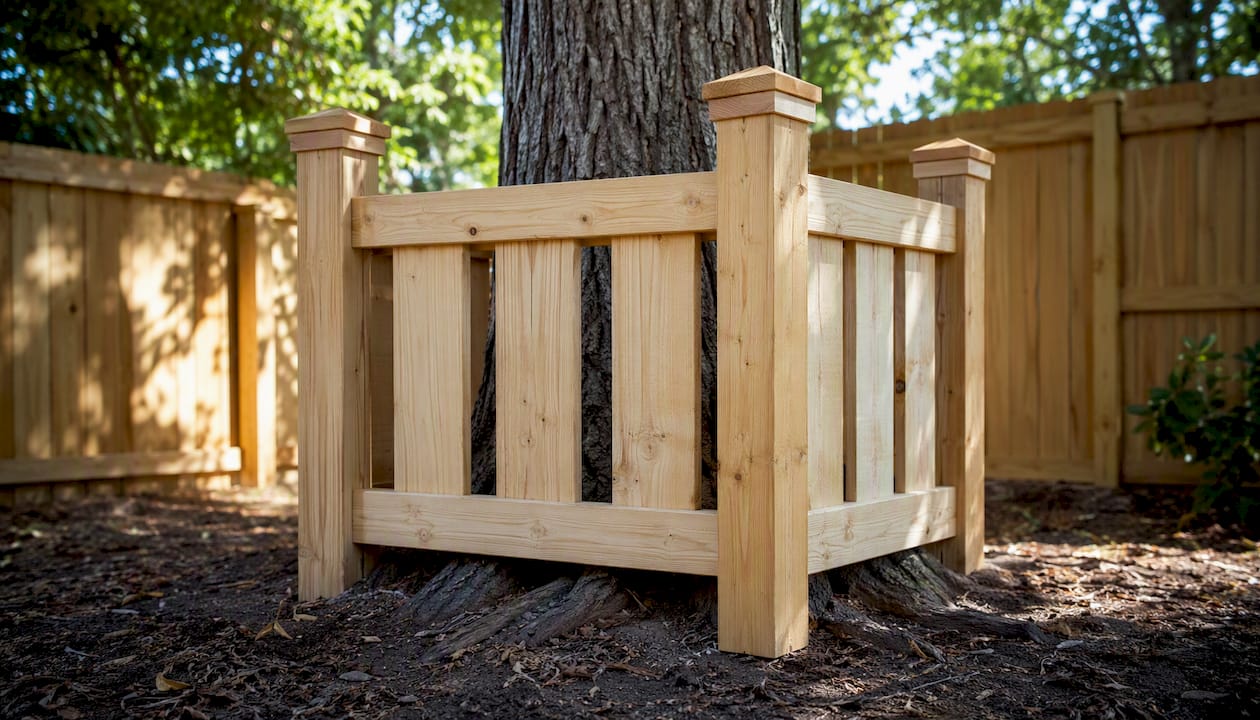
The trade-off: it adds material cost and creates two inside corners that can collect debris. Visually, a bump-out is obvious, though a skilled installer can minimize it.
Gap/terminate
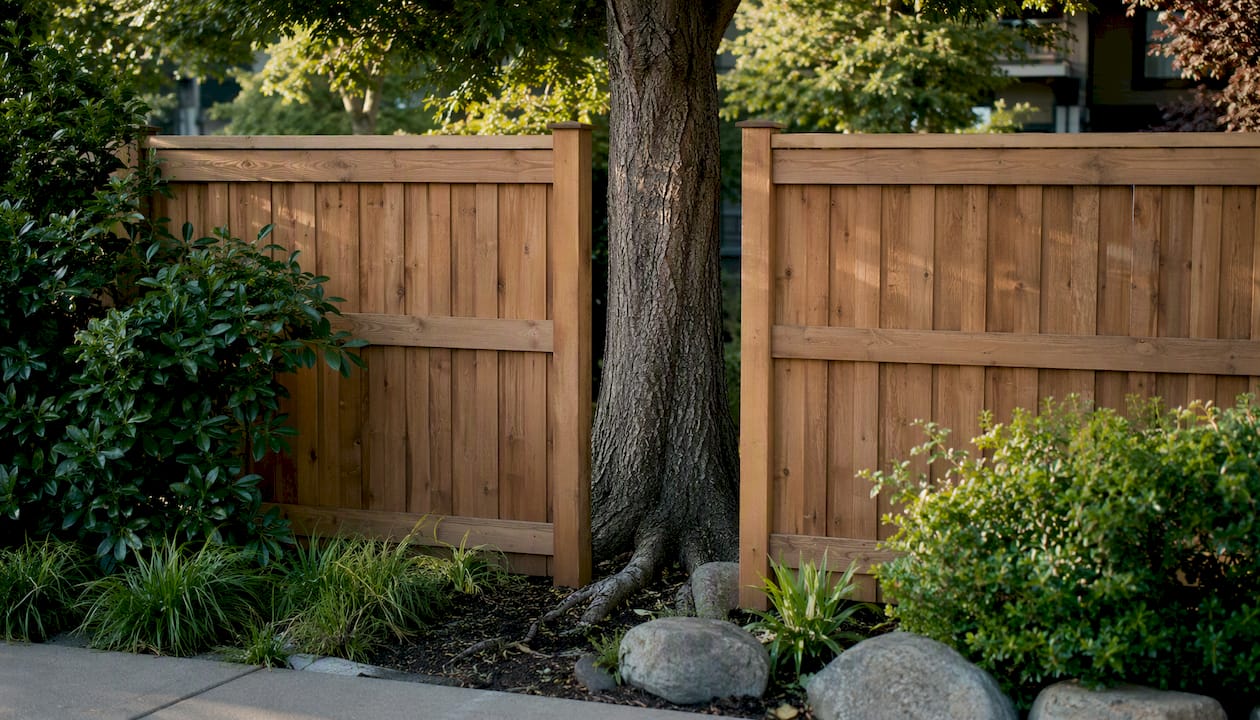
The simplest option. The fence runs to within a safe distance of the trunk on each side and stops. No special framing, no custom cuts. For a backyard privacy fence where the tree is near a corner, a gap of 12–18 inches on each side is often unnoticeable. For a perimeter fence meant to contain pets or children, a gap is a real problem unless you add a separate gate or panel to close it.
Contour-cut panels
Panels are notched or curved to follow the trunk’s profile, leaving roughly a 2-inch gap between the material and the bark. This is the cleanest-looking solution, but it requires rework every few years as the trunk expands. If the panel ever presses against the bark, it creates a wound that invites disease and insects. Some species, like oaks and maples, add trunk girth faster than others, so the maintenance interval shortens.
| Method | Best for | Root impact | Future adjustment needed | DIY difficulty |
|---|---|---|---|---|
| Bump-out (box) | Large trees, continuous barriers | Low (posts set outside PRZ) | Minimal | Moderate |
| Gap/terminate | Non-containment fences, corner trees | Very low | None | Easy |
| Contour-cut panels | Aesthetics, small trunks | Low if clearance maintained | Yes, every 2–4 years | Moderate to hard |
- Bump-outs add a moderate amount of extra fencing length per tree, depending on the size of the box.
- Gaps work only when containment is not the fence’s primary job.
- Contour panels pressed against bark are worse than no fence at all for tree health.
Pro Tip: For boundary trees, confirm ownership before choosing a method. A bump-out that extends onto a neighbor’s property without written consent can trigger a fence dispute even if the tree itself is shared.
How to install a fence near trees: a step-by-step checklist
Pre-install checklist
Before you buy a single post, work through this list:
- Confirm the property line. Pull your plat map or hire a licensed surveyor. Guessing costs more to fix than a survey costs upfront. Advantagefencenj can help coordinate boundary survey guidance for homeowners who need it.
- Call 811. Mark the dig date on your calendar and call at least three business days ahead.
- Check local permit rules. Most municipalities require a permit for any fence over a certain height (commonly 4–6 feet). Some add an arborist report requirement when the fence line enters a protected tree’s critical root zone. Permit fees in residential contexts typically run $25–$200, though that varies by county.
- Measure DBH and map the PRZ. Wrap a tape around the trunk at 4.5 feet above grade. Divide the circumference by 3.14 to get diameter (DBH). Multiply by 1.5 to get the minimum PRZ radius in feet. Mark that circle on the ground with spray paint or flags.
- Decide your routing method (bump-out, gap, or contour) based on the tree’s size, the fence’s purpose, and your neighbor situation.
Materials and tools
- Posts: pressure-treated 4×4 wood, aluminum, or vinyl (match your panel material)
- Surface-mounted post brackets (Simpson Strong-Tie or equivalent) for no-dig installs near roots
- Hand-digging tools: spade, digging bar, root saw for any unavoidable small roots
- Air-spade rental (optional but strongly recommended inside or near PRZ)
- Flexible mesh or chain-link panels for contour applications
- 3-inch mulch (wood chips, not dyed bark) for the area inside the PRZ
- Level, string line, post-hole digger (for locations outside the PRZ only)
Step-by-step installation
- Mark the fence line with stakes and string, incorporating your chosen routing method around the tree.
- Locate post positions with offsets that keep every post at least 1 PRZ radius away from the trunk. If a post must land closer, plan for a surface-mounted bracket instead of a dug hole.
- Hand-dig or use an air-spade for any post within 10 feet of the trunk. A mechanical auger inside the PRZ can sever major lateral roots in seconds. Standard alternatives to power augers include hand-digging, pneumatic excavation, or shifting post locations entirely.
- Set posts. For dug posts outside the PRZ, set to standard depth (typically one-third of post length) and backfill with the removed soil. Do not import fill soil inside the PRZ; grade changes suffocate roots.
- Attach panels or mesh, leaving the 1.5–2 inch bark clearance for contour methods. Use stainless or galvanized fasteners to resist rust near soil.
- Apply 3 inches of wood-chip mulch inside the PRZ to retain moisture and reduce compaction. Keep mulch away from the trunk itself (leave a 2-inch ring of bare soil around the base).
- Inspect and adjust. Walk the line, check clearances, and confirm no panel or post is in contact with bark.
Pro Tip: Surface-mounted post brackets are the single best tool for protecting roots near trees. They bolt to a concrete pad or existing hardscape and eliminate digging entirely. The install takes longer to plan but saves the tree.
How to calculate safe distances using DBH and PRZ math
The math behind tree protection is simpler than it sounds. DBH stands for Diameter at Breast Height, measured at exactly 4.5 feet above the ground. That single number drives every safe-distance calculation on the job.
Purdue Extension’s construction and tree protection guidelines recommend using a multiplier of 1–1.5 times DBH (in inches) to determine the PRZ radius in feet. So a tree with a 12-inch DBH needs a protected zone with a radius of 12–18 feet. That is a large circle, and it surprises most homeowners.
The root-loss threshold matters as much as the radius. Cutting more than roughly 25% of the roots within the PRZ significantly reduces a tree’s chance of long-term survival. A single post-hole dug through a major lateral root can cross that threshold for a smaller tree.
Soil compaction is the other hidden killer. Heavy foot traffic, equipment staging, or even stacked lumber inside the TPZ compresses the soil pores that roots need for oxygen and water. Texas A&M Forest Service recommends erecting sturdy protective fencing, applying a 3-inch mulch layer inside the TPZ, and prohibiting all digging and material storage within the zone.
Protective measures that actually work:
- Temporary TPZ fencing erected before any work begins (chain-link panels on driven stakes work well)
- 3-inch wood-chip mulch layer across the entire TPZ floor
- Posted signage: “Tree Protection Zone — No Equipment, No Storage, No Digging”
- No grade changes inside the TPZ, either cutting or filling
- Watering the tree during and after any root pruning, especially in dry months
NC State Extension recommends identifying TPZ boundaries on site plans, fencing them before clearing begins, and enforcing restrictions until all work is complete. For any fence work that falls inside the PRZ, an ISA Certified Arborist should review the plan and sign off on root pruning if it is unavoidable. ANSI A300 standards govern how and when roots may be cut.
What to do when the tree is on or near the property line
A tree straddling a property line is legally co-owned in most U.S. states. That changes everything about how you plan the fence. You cannot simply build through or around it without your neighbor’s knowledge, and in some states, you cannot remove a shared tree without written consent from both owners.
Start with a professional boundary survey. A plat map from the county recorder is a starting point, but it is not a substitute for a licensed surveyor’s stakes on the ground. A professional boundary survey is the only reliable way to confirm ownership before building, and it is the document your permit office will likely require anyway.
Steps for a boundary-tree situation:
- Talk to your neighbor first. A conversation before the permit application prevents most disputes. Agree on the routing method and document it in writing.
- Get written consent for any work that affects a shared tree, including root pruning or post placement near its base.
- Submit a site plan with your permit application. Show the tree location, the fence line, and the PRZ boundary. Some municipalities require an arborist report when the fence enters a protected tree’s zone.
- Keep a copy of the permit on site during installation. Inspectors do show up.
- Check local shared-fence rules. Some states have 30-day notice requirements before building a fence on or near a shared boundary. Your local planning department is the right place to ask.
A few states also have protected-tree ordinances that apply regardless of property line. Heritage or specimen trees above a certain DBH may require a separate permit or outright prohibit any work within their PRZ. Check with your municipality before assuming the standard fence permit covers everything.
Common mistakes when fencing near trees, and how to fix them
Mistakes and immediate fixes
- Post hole dug through a major root: Stop. Consult an ISA Certified Arborist before backfilling. The arborist can assess root damage and advise on whether a clean cut or relocation of the post is the better path.
- Panel or rail rubbing against bark: Add a rubber spacer or recut the panel to restore the 1.5–2 inch clearance. Bark contact creates wounds that do not heal cleanly and invite fungal infection.
- Soil compaction inside the PRZ from foot traffic or equipment: Aerate with a hand aerator or air-spade, then apply fresh mulch. Avoid the area with heavy loads going forward.
- Grade raised inside the TPZ with fill soil: Remove the fill. Even 2–3 inches of added soil over a root system can suffocate feeder roots within a growing season.
- Fence attached directly to the trunk with nails or screws: Remove the fasteners immediately. Open wounds in bark are entry points for disease. Replan the panel attachment using a freestanding post nearby.
Maintenance schedule
- Annually: Walk the fence line and check every panel near a tree for bark contact. Tighten any loosened fasteners. Measure the gap between panel and trunk; if it has closed to under an inch, recut or reposition.
- Every 2–3 years: Check mulch depth inside the PRZ and top up to 3 inches if it has broken down. Inspect post stability near root zones, as roots growing under a post base can shift it over time.
- After any major storm: Look for leaning posts, displaced panels, and any new contact between fence material and bark.
Red flags that need a professional, not a weekend fix: trunk wounds that are not callusing over, canopy dieback on the side facing the fence, posts that have shifted more than an inch from their original position, or any sign that roots are lifting the fence line. Post-construction monitoring, including maintaining mulch and watering during dry periods, is a documented factor in tree survival after nearby work.
Pro Tip: Take a photo of the trunk-to-panel gap every spring. A two-year photo comparison tells you exactly how fast the trunk is expanding and whether you need to recut panels before they make contact.
When a professional installation is the smarter call
Some fence projects near trees are genuinely DIY-friendly. A gap/terminate on a small yard tree with posts set well outside the PRZ? Most capable homeowners can handle that. But a few situations call for a professional fencing contractor, and trying to DIY them usually costs more to fix than the installation would have cost in the first place.
Hire a pro when:
- The fence line runs inside or very close to the PRZ of a mature tree
- The tree sits on or near the property line and neighbor coordination is needed
- Your municipality requires an arborist report or a stamped site plan
- You want a lasting, code-compliant installation with a warranty

Advantagefencenj handles the full scope of tree-adjacent fence installations across Gloucester, Camden, Burlington, and Atlantic County. That means a site visit to map the PRZ, material selection across wood, vinyl, aluminum, and chain-link options, permit application support, and coordination with an ISA Certified Arborist when the project calls for it. Surface-mounted post brackets and non-dig solutions are part of the standard toolkit, not an upsell.
Professional tree protection plans sometimes include contractual obligations and financial bonds that hold contractors accountable for tree preservation outcomes. Advantagefencenj builds tree-protection measures into every contract near significant trees, so you have documentation if a question arises later.
Ready to get a quote? Contact Advantagefencenj for a site visit and proposal. The estimate is free, and the team brings the PRZ math to the property so you know exactly what the plan protects.
A note from the installer
Installing fences near mature trees is one of the more satisfying parts of this work, precisely because it requires actual thinking. A fence that goes in wrong can quietly stress a 40-year-old oak for years before anyone connects the dots. Getting it right means the tree stays healthy, the fence holds its line, and the homeowner does not get a call from a neighbor or an arborist five years later.
At Advantagefencenj, tree-adjacent installs are not a specialty niche. They are a regular part of what we do in South Jersey, where mature trees and older property lines go hand in hand. The projects that matter most are the ones where we leave both the fence and the tree better than we found them.
Sources
These sources informed the guidance throughout this article and are worth bookmarking if you want to go deeper:
- How to Build a Fence Around a Tree on the Property Line – LegalClarity
- Protect Tree Roots During Construction – Texas A&M Forest Service
- Construction and Trees: Guidelines for Protection • FNR-463-W
- Construction and Tree Protection | NC State Extension Publications
- Protecting trees during construction – Colorado State Extension