

Yes, a properly designed noise reducing fence can cut outdoor noise by a meaningful amount. Real-world residential acoustic fences typically deliver 8–15 dB(A) of insertion loss, and FHWA research confirms that well-built barriers commonly reduce traffic noise by 5–10 dB, with reductions around 10 dB roughly halving perceived loudness. But “soundproof” is a misnomer outdoors. Sound diffracts over the top, leaks through gaps, and wraps around ends. Before you choose a material or call a contractor, get three things right first:
- Height: The fence must break the direct line-of-sight between the noise source and your ears. Every additional meter of height after that point adds roughly 1.5 dB of reduction.
- Continuity: No gaps. A 10 mm opening at the base can effectively cancel the performance of an otherwise well-built fence.
- Mass: Panels need a surface density of at least 10 kg/m² to block transmission meaningfully. Gains above ~15–20 kg/m² provide diminishing returns, as diffraction over the top becomes the limiting factor, not the panel itself.
For a modest backyard neighbor-noise problem, a careful DIY build can work. For serious road or rail noise, or any fence that needs to exceed your local height limit, hire a professional and consider an acoustic site assessment.
Key Takeaways
A well-designed, properly sealed noise reducing fence delivers 8–15 dB(A) of real-world insertion loss when height, continuity, and placement are all correct.
| Point | Details |
|---|---|
| Height above line-of-sight | Each meter above the direct line-of-sight typically adds a small but important increment of noise reduction. |
| Seal every gap | A 10 mm gap at the base or gate can cancel the performance of an otherwise well-built fence. |
| Mass has a ceiling | Panels need at least 10 kg/m² to begin providing meaningful acoustic reduction; gains above 15–20 kg/m² give diminishing returns due to diffraction. |
| Realistic dB expectations | Real-world insertion loss runs 8–15 dB(A); lab Rw figures of 24–32 dB do not translate directly to your yard. |
| Advantagefencenj for pro installation | Advantagefencenj provides site assessments, permit assistance, sealed-detail installation, and written estimates for acoustic fence projects. |
Table of Contents
- How does a noise barrier actually reduce sound?
- Which materials perform best for noise reduction?
- What design rules actually determine performance?
- What noise reduction should you realistically expect?
- How much does a noise-reducing fence cost?
- How do you hire the right contractor for an acoustic fence?
- Permits, installation, and maintenance
- Research findings homeowners can rely on
- What installers see that homeowners miss
- Advantagefencenj can assess your property and design a fence that actually performs
- Sources
How does a noise barrier actually reduce sound?
Sound travels in waves. The most direct path from a road or neighbor’s yard to your patio is a straight line, and that direct path carries the most energy. A sound blocking fence works primarily by physically interrupting that path.
The line-of-sight rule
Once a barrier rises high enough to block the direct visual line between the noise source and the receiver (your ears at seated or standing height), it starts doing real acoustic work. According to FHWA guidance, each additional meter of height beyond that break point adds approximately 1.5 dB of noise reduction. That sounds modest, but 3 extra meters above line-of-sight is 4.5 dB, which is perceptible. Barrier effectiveness is highest within roughly the first few dozen meters of the source. Beyond that distance, the geometry works against you.
Diffraction, transmission, and reflection
Diffraction is the main enemy. Sound bends over the top of a barrier and around its ends, which is why a short fence or one that stops at your property line rarely performs as well as expected. The longer the run and the higher the top edge, the less diffraction undermines your investment.
Transmission through the panel matters too, but only up to a point. Once surface mass density reaches roughly 15–20 kg/m², SLR Consulting’s acoustic barrier guidance confirms that additional mass adds little because diffraction, not transmission, becomes the binding constraint.
Reflection is the third factor, and it cuts both ways. A hard reflective surface bounces sound away from your yard but can increase noise on the opposite side or create canyon effects between two parallel walls. FHWA’s design notes on reflective versus absorptive barriers recommend absorptive facings on the source side when parallel barriers face each other or when the opposite side is also occupied.
The practical takeaway: A fence that blocks the sightline, runs long enough to prevent flanking, and has no gaps will outperform a taller fence with poor sealing and short ends every time. Geometry and continuity beat raw mass.
Which materials perform best for noise reduction?
Not all fence materials are equal acoustically. The right choice depends on your noise source, your budget, and how much the fence needs to blend into the yard.
Material comparison
| Material | Surface density | Typical insertion loss (on-site) | Best use case |
|---|---|---|---|
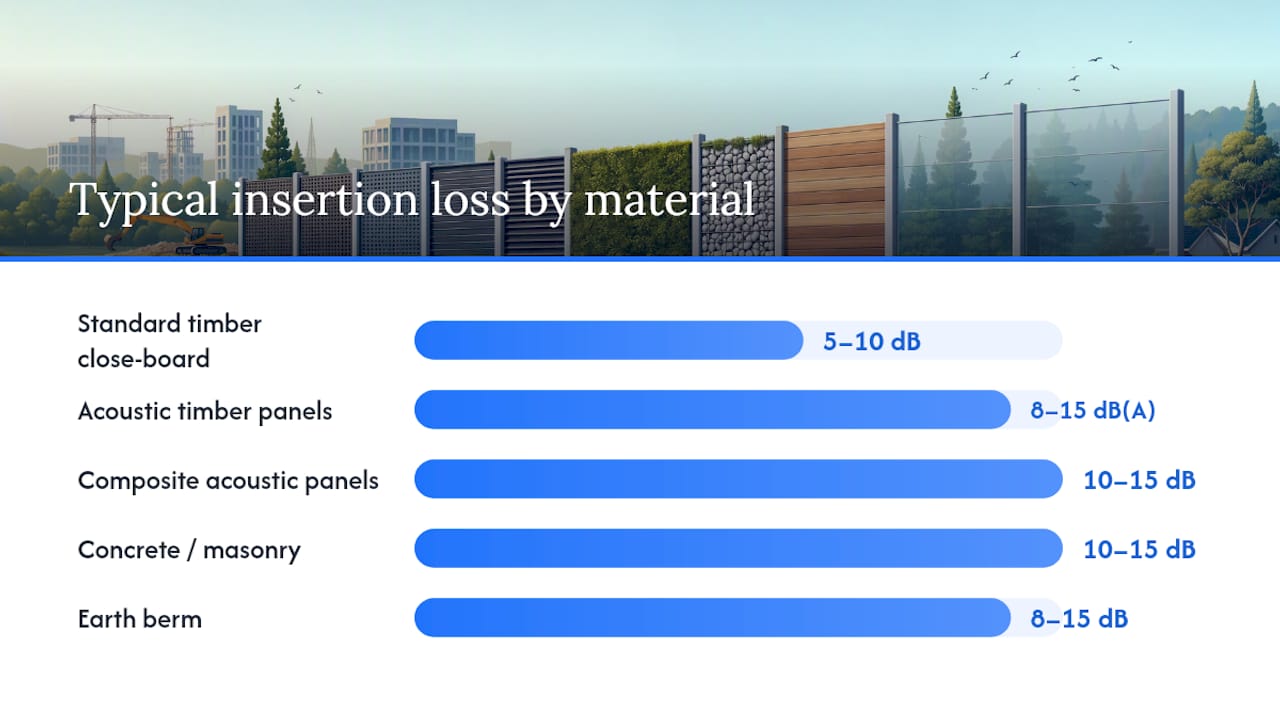
| Standard timber close-board | ~12–15 kg/m² | 5–10 dB | Neighbor/garden noise, low-traffic roads |
| Acoustic timber panels | ~15–20 kg/m² | 8–15 dB(A) | Moderate road noise, residential boundaries |
| Panels need at least 10 kg/m² to provide meaningful noise reduction. Increasing surface mass above 15–20 kg/m² has little effect on performance unless the fence’s geometry and sealing are also optimal. | |||
| Composite acoustic panels | ~20–30 kg/m² | 10–15 dB | Road/rail noise, commercial boundaries |
| Concrete/masonry | 30–50+ kg/m² | 10–15 dB (site-limited by diffraction) | Heavy traffic, industrial, long runs |
| Earth berm | Varies | 8–15 dB | Highway setbacks, large lots |
A few things worth knowing about each:
- Standard timber close-board is the most common residential fence. It provides useful privacy and modest noise reduction, but gaps between boards and at the base are the norm unless you specify acoustic detailing.
- Acoustic timber panels use thicker boards, overlapping joints, and sealed gravel boards to hit higher surface densities. Manufacturer testing shows controlled-condition results up to ~26–29 dB, though real-world installation typically lands in the 8–15 dB range.
- Absorptive panels with stone-wool cores, such as Rockwool Noistop, add an absorptive layer that reduces reflections on the source side. These are particularly useful when your property sits between a road and a neighbor, or when a reflective surface would bounce noise toward someone else.
- Concrete and masonry have high mass and long lifespans but are expensive, require proper foundations, and offer no visual warmth. They work well for long highway-adjacent runs where aesthetics are secondary.
- Earth berms perform well acoustically and integrate naturally into landscaping, but they require significant land area and are impractical on most suburban lots.
- Vegetation alone (hedges, trees) provides psychological comfort and some wind buffering but delivers negligible acoustic reduction for traffic noise unless the planting is several meters deep and dense throughout.
DIY retrofits like mass-loaded vinyl blankets can add modest improvement to an existing fence, but they degrade outdoors, look industrial, and rarely match the performance of a purpose-built sealed system.
Pro Tip: If you’re choosing between a taller standard fence and a shorter acoustic-grade panel fence, go taller first. Height gains above line-of-sight outperform mass gains beyond 15–20 kg/m² in most residential settings.
What design rules actually determine performance?
Getting the design right matters more than the material spec sheet. These are the decisions that separate a fence that works from one that disappoints.
Height and line-of-sight
Measure the height of the noise source (road surface, neighbor’s HVAC unit, etc.) and the height of the receiver (seated ear height is roughly 1.2 m; standing is ~1.6 m). The fence must clear both. For ground-level road noise and a seated listener 10 meters back, a 1.8 m (6 ft) fence often breaks line-of-sight. For a first-floor window, you may need 2.4 m or more, which triggers permit requirements in most U.S. jurisdictions.
Most U.S. municipalities cap residential fences at 6 ft (roughly 1.8 m) in rear yards and 4 ft in front yards, though rules vary by city and HOA. Check your local zoning ordinance before specifying height.
Length and end effects
A fence that stops at your property line leaves flanking paths on both sides. FHWA barrier optimization principles applied to residential contexts suggest the barrier should extend well past the protected area on both ends. A practical rule: the fence run should be at least 4 times the distance from the fence to the receiver. If your patio is 5 meters from the fence, the run should extend at least 20 meters in each direction beyond the seating area. Returns (short perpendicular sections at each end) help close flanking paths without requiring an infinitely long run.
Continuity and sealing
This is where most residential acoustic fences fail. SLR Consulting’s guidance is unambiguous: even small gaps of a few millimeters significantly undermine performance. Sound finds the path of least resistance, and a gap at the base or a loose gate seal is exactly that.
Inspect or specify these details:
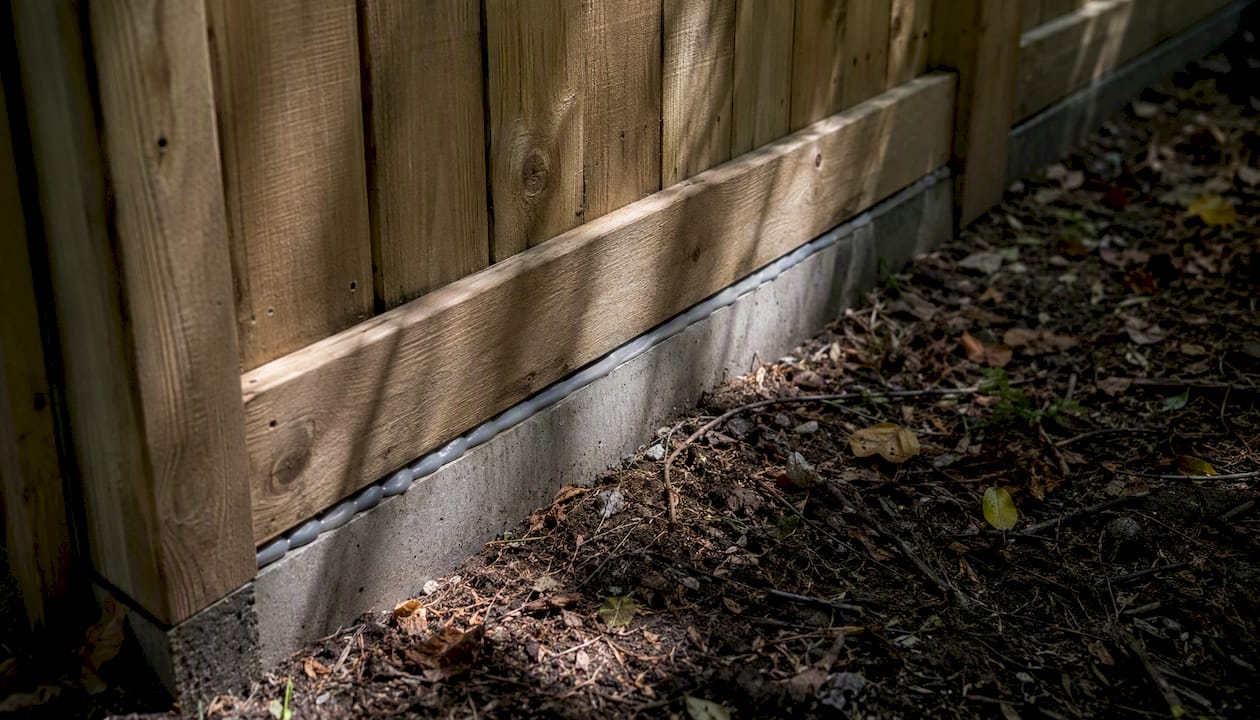
- Gravel board: A sealed concrete or composite gravel board at the base eliminates the gap between fence and ground. This is non-negotiable for acoustic performance.
- Post-to-panel joints: Boards should overlap or be sealed; gaps between boards and posts are common failure points.
- Gates: A gate with a 10 mm gap around its perimeter is acoustically equivalent to a hole in the wall. Specify brush seals, drop bolts, and overlapping frames.
- Top cap: A capping rail or top diffractor reduces diffraction slightly and protects the top edge from moisture, which prevents warping and future gaps.
Pro Tip: Ask any contractor to show you photos of their gravel board and gate seal details from a previous acoustic job. If they can’t, that’s your answer.
Proximity to source vs. receiver
Placing the fence closer to the noise source is more effective than placing it close to the receiver. A fence 2 meters from the road edge outperforms the same fence 10 meters from the road and 2 meters from your patio, all else equal. On most residential lots, you’re constrained by property lines, but the principle matters when you have a choice.
What noise reduction should you realistically expect?
The gap between what a manufacturer’s test sheet says and what you experience in your backyard is real and predictable. Lab-rated Rw values for acoustic fence panels often reach 24–32 dB, but on-site insertion loss for residential installations typically lands at 8–15 dB(A). The difference comes from diffraction over the top, flanking around ends, ground reflections, and the fact that lab tests measure transmission only, not the full acoustic path.
FHWA’s highway barrier data puts typical reductions at 5–10 dB, with favorable conditions reaching 10–15 dB. Maryland SHA research on short concrete barriers found 3–5 dB for at-grade roadways and up to 9 dB for elevated roadways under specific conditions, which is a useful reality check for homeowners near raised highways.
A 10 dB reduction roughly halves perceived loudness. An 8 dB reduction is clearly noticeable. A 3 dB reduction is just perceptible. Set your expectations accordingly before spending on premium materials.
When performance falls short
Watch for these red flags in any design or existing installation:
- Visible daylight under the fence or between boards
- Fence run that ends well short of the protected area
- Receiver (window, patio) clearly above the fence top
- Property on a hillside above the noise source
- Parallel reflective surfaces creating a channel effect
- Gates with no seals or large clearance gaps
Hillside properties are a particular challenge. If your home sits above the road, the fence would need to be impractically tall to break line-of-sight, and FHWA data confirms that homes elevated above a barrier receive little benefit.
How much does a noise-reducing fence cost?
Cost varies significantly by material, height, site conditions, and region. These are realistic installed ranges for U.S. projects:
- Budget timber close-board (acoustic detailing): $25–$50 per linear foot installed, depending on height and site access
- Acoustic composite panels: $50–$100 per linear foot installed
- Concrete or masonry wall: $80–$150+ per linear foot, higher with footings and retaining walls
- Earth berm (with seeding/planting): Highly variable; typically $30–$80 per linear foot equivalent, requires significant lot area
For aluminum fencing, budgeting guidance from Advantagefencenj covers cost drivers that apply across material types.
What drives cost up
- Height: Every foot above 6 ft adds material, labor, and often permit costs.
- Ground conditions: Rocky soil, slopes, or poor drainage require deeper posts and more prep.
- Foundations: Concrete panels and masonry need engineered footings.
- Sealing and detailing: Acoustic-grade gravel boards, brush seals on gates, and capping rails add cost but are worth it.
- Permits and acoustic assessments: A professional acoustic survey (LAeq measurement and ISO 9613-2 modeling) typically runs $500–$2,000 depending on scope.
- Returns and end sections: Perpendicular end runs add material but meaningfully improve performance.
Where to spend and where to save
Invest in height (up to the permit limit), sealing details, and returns. These have the highest acoustic return per dollar. Adding mass beyond ~20 kg/m² gives diminishing returns because diffraction, not transmission, is the limiting factor at that point. Spending on premium decorative finishes before you’ve solved the sealing and height problem is the most common budget mistake.
Sample scenarios:
- Modest backyard neighbor-noise fix: 40 linear feet of acoustic timber fence at 6 ft, sealed gravel board, sealed gate. Budget: $2,000–$3,500 installed.
- Serious road noise mitigation: 120 linear feet of composite acoustic panels at 7–8 ft with returns, permit, and acoustic assessment. Budget: $12,000–$22,000 or more depending on region and site conditions.
How do you hire the right contractor for an acoustic fence?
Most fence contractors can build a standard privacy fence. Fewer understand the acoustic details that determine whether a sound reducing fence actually performs. Here’s how to tell the difference.
Questions to ask before signing anything
- Can you show me photos of gravel board and gate seal details from a previous acoustic installation?
- What surface density will the panels achieve, and do you have a spec sheet?
- Where will the fence sit relative to the noise source, and have you checked line-of-sight?
- Do you handle permit applications, and have you pulled permits for acoustic fences in this municipality before?
- What warranty covers acoustic performance and workmanship, and what does it exclude?
- Can you provide references from homeowners who installed acoustic fences near a road or rail line?
Red flags to walk away from
- Vague answers about sealing (“we’ll caulk it”) with no detail on gravel boards or gate hardware
- No examples of acoustic-specific work, only standard privacy fences
- A bid that omits site prep, gravel boards, or gate seals from the scope
- Steeply low price that doesn’t account for height, foundations, or detailing
- Refusal to provide a written scope with materials, surface densities, and guarantees
What a good proposal looks like
A solid proposal includes: a drawing showing fence height and run length with measurements, a materials list specifying panel surface density or tested Rw where available, gate detail with seal type, gravel board specification, post type (concrete or pressure-treated), maintenance notes, and payment milestones tied to installation stages.
Advantagefencenj provides site assessments and written estimates that cover height, placement, materials, and permit requirements, so you know exactly what you’re getting before any work begins. A pre-installation property survey is part of that process, which catches boundary and grade issues before they become change orders.
Permits, installation, and maintenance
Permitting basics
Most U.S. municipalities allow rear-yard fences up to 6 ft without a permit and front-yard fences up to 4 ft. Anything taller typically requires a building permit, and some jurisdictions require neighbor notification or a variance hearing. HOA rules often impose stricter limits on height, material, and color. Check both your local zoning ordinance and your HOA covenants before finalizing any design.
For fences near property lines, a survey for fence placement prevents boundary disputes and ensures your fence sits where it needs to acoustically.
Installation details that matter acoustically
- Post depth: A minimum of one-third of total post length below grade, set in concrete, prevents movement that opens panel joints over time.
- Gravel board: Install a concrete or composite gravel board at the base, sealed to the ground contour. This is the single most important detail for long-term acoustic performance.
- Panel installation: Boards should overlap or be tongue-and-groove; butt joints with no overlap are a gap waiting to happen.
- Gate seals: Fit brush seals on all four edges, a drop bolt at the base, and an overlapping frame. Test the seal by looking for light around the perimeter when the gate is closed.
- Top cap: A capping rail protects the top edge from moisture and reduces warping that opens joints.
Maintenance checklist
Inspect annually and after any significant storm:
- Check gravel board contact with the ground; re-seal any gaps with acoustic sealant
- Inspect post-to-panel joints for movement or gaps
- Test gate seals; replace brush seals when compressed
- Treat timber with preservative to prevent warping
- Look for board shrinkage or movement that opens joints; re-fix or replace boards as needed
One practical note on neighbors and environment: a tall solid fence changes the visual character of a property line. Planting climbing plants or shrubs on the receiver side softens the appearance and reduces the likelihood of neighbor objections, which can delay or block permit approvals.
Research findings homeowners can rely on
The numbers below come from FHWA research, Maryland SHA testing, and acoustic consulting guidance. Use them to evaluate contractor claims and design proposals.
| Source | Key finding | Implication for homeowners |
|---|---|---|
| FHWA | 5–10 dB typical reduction; 1.5 dB per meter after line-of-sight blocked | Height above line-of-sight is the most reliable lever |
| FHWA | Most effective within ~61 m (200 ft) of source | Properties far from the road get less benefit |
| SLR Consulting | Surface mass ≥10 kg/m² needed; diminishing returns above 15–20 kg/m² | Don’t overspend on mass; invest in height and sealing |
| Maryland SHA | Short concrete barriers: 3–5 dB at-grade, up to 9 dB for elevated roads | Short barriers can still help near raised highways |
Optimization principle: FHWA’s TNM barrier cost-benefit approach finds the point of diminishing returns rather than maximizing height at all cost. The same logic applies to your backyard: a well-sealed 6 ft fence in the right position usually outperforms a poorly detailed 8 ft fence.
For serious noise sources (a highway, rail line, or industrial facility), a qualified acoustic consultant should measure LAeq and LAmax on site, model barrier performance using ISO 9613-2 or TNM, and provide predicted insertion loss for your specific receiver positions before you commit to a design.
What installers see that homeowners miss
Most homeowners who come to us after a disappointing DIY acoustic fence share the same story: they bought the right panels and then lost all the performance at the base and the gate. A gap you can barely see in daylight is acoustically significant. Sound at low frequencies behaves more like water than like light, and it finds every opening.
The second most common mistake is building a fence that’s the right height at the property line but stops 10 feet short of the patio on each side. The flanking paths around the ends carry more energy than most people expect, and no amount of panel mass fixes a geometry problem.
What a proper site visit actually involves: walking the boundary with the homeowner, identifying the noise source elevation and the receiver positions (seated patio, bedroom window, play area), checking grade changes that affect gravel board sealing, and measuring the run length needed to close flanking paths. That assessment takes 30–45 minutes and changes the design in almost every case.
For homeowners considering noise control throughout the home, pairing an exterior acoustic fence with noise-reducing interior door options addresses both the outdoor and indoor transmission paths, which is the combination that makes a real difference in livability.
Advantagefencenj can assess your property and design a fence that actually performs
Quieter outdoor spaces require a fence that’s designed for acoustics, not just privacy. Advantagefencenj brings site-specific assessment, acoustic detailing, and permit experience to every project, so you get a written proposal that specifies panel surface density, gravel board type, gate seal hardware, and run length before any work starts.
The first visit covers: noise source identification, line-of-sight measurement, height and placement recommendations within your local zoning limits, material options with realistic dB expectations, and a full written estimate with materials and labor broken out. Advantagefencenj handles permit applications and coordinates with HOAs where required.
For homeowners ready to move from research to results, request a site assessment and estimate or review the full range of fencing services Advantagefencenj offers to find the right system for your property and budget.
Sources
- Highway Traffic Noise Barriers at a Glance – Design Construction – Noise Barriers – Noise – ENVIRonment – FHWA
- How to get acoustic barriers just right | SLR Consulting
- Short-Solid Barriers Report (Maryland SHA research)
- TNM best practices and noise barrier optimization | FHWA
- How to Choose Acoustic Fencing UK | dB Ratings, Timber & Standards