

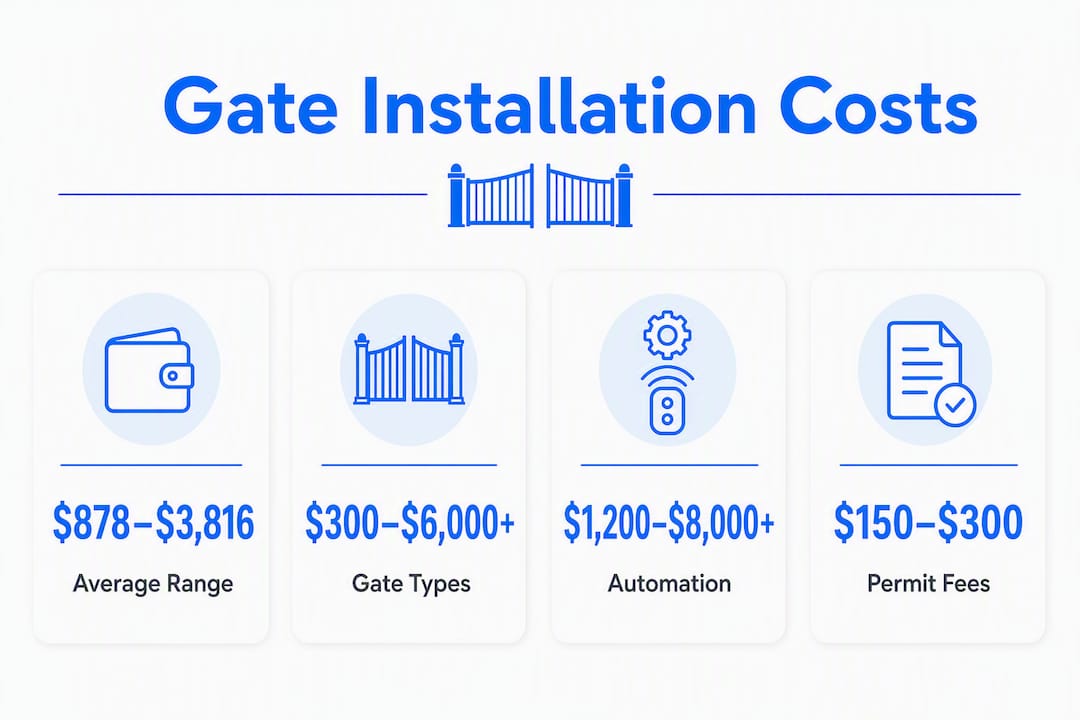
Most homeowners pay between $878 and $3,816 for a professionally installed residential gate, though that range covers a lot of ground. A basic pedestrian gate in wood or chain-link typically runs a few hundred dollars installed. A manual driveway gate can cost several thousand dollars depending on width and material. Add automation, and you’re looking at $2,380–$8,000 or more for a complete automatic gate installation.
Three factors move the needle most: material, automation, and site prep. Everything else is secondary.
Here’s the quick snapshot for 2026:
- Pedestrian gate (manual, 3–5 ft): $300–$900 installed
- Single driveway gate (manual, 10–12 ft): $1,200–$3,500 installed
- Double driveway gate (manual, 12–16 ft): $1,800–$5,000 installed
- Automated driveway gate (single or double): $2,380–$8,000+ installed
- Custom steel or ornamental iron with full automation: $10,000–$12,000+
Ready to skip the estimates and get a real number for your property? Get a local, itemized quote from a licensed installer before committing to any budget.
Table of Contents
- How much does gate installation cost by gate type?
- How material choices affect what you pay now and later
- What does gate automation actually cost?
- What pro installers charge and what a real quote looks like
- Permits, HOA approvals, and what triggers an inspection
- Two real project examples with line-item budgets
- What drives your price up (and what to watch for in bids)
- What to expect from quote to finished installation
- Annual maintenance costs and long-term ownership
- How to get accurate, comparable quotes from contractors
- Choosing gate materials by climate and maintenance willingness
- Key Takeaways
- What installers see that homeowners miss
- Advantagefencenj handles the whole project, not just the gate
- Useful sources
How much does gate installation cost by gate type?
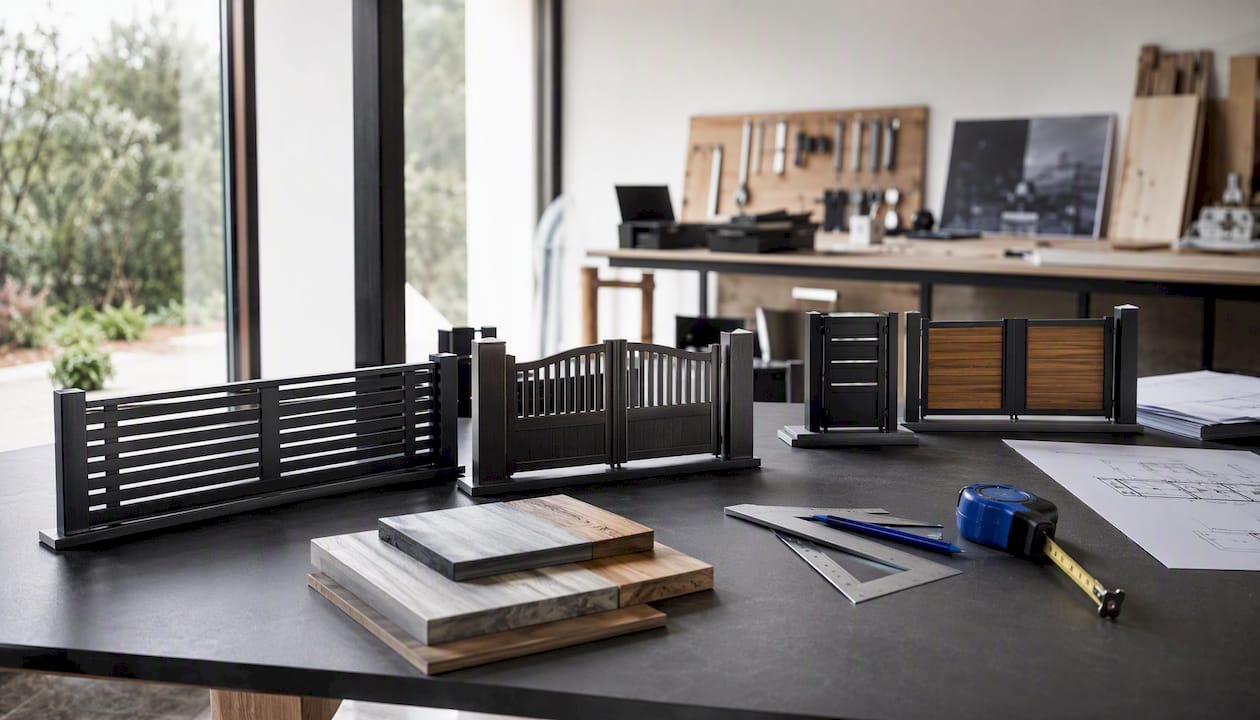
The type of gate you choose shapes the budget more than most homeowners expect. A sliding gate on a sloped driveway costs more than a swing gate on flat ground, even when the materials are identical. Here’s how the major types compare:
| Gate Type | Typical Low | Typical Average | Typical High |
|---|---|---|---|
| Pedestrian (3–5 ft, manual) | $300 | $600 | $900 |
| Single swing driveway (10–12 ft) | $1,200 | $2,500 | $4,500 |
| Double swing driveway (12–16 ft) | $1,800 | $3,500 | $6,000 |
| Sliding gate (10–16 ft) | $2,000 | $4,500 | — |
| Cantilever sliding gate | $3,000 | $6,000 | $12,000+ |
| Automated single swing | $2,500 | $4,000 | $7,000 |
| Automated double swing | $3,500 | — | $10,000 |
Single swing gates are the most common choice for residential driveways up to 12 feet wide. They’re mechanically simple, easier to automate, and work well on level ground. The main constraint is clearance: the gate needs room to arc open, which rules them out for tight entries or driveways that slope sharply upward from the street.
Double swing gates split the opening into two leaves, which halves the swing arc needed on each side. That makes them practical for wider openings (12–16 ft) where a single leaf would need too much clearance. They cost more because you’re paying for two gate panels, two sets of hinges, and two actuators if automated.
Sliding gates run on a track along the fence line, which makes them the go-to for sloped driveways or tight spaces. The tradeoff: they require a track, rollers, and a clear run of fence line equal to the gate width. That hardware adds cost, and on a slope, the track installation gets complicated fast.
Cantilever sliding gates eliminate the ground track entirely. The gate hangs from a top rail and slides on rollers mounted to posts, which is ideal for uneven or gravel surfaces. They’re the most expensive option in this category but often the most reliable long-term.
Wide openings for RV access increase costs notably due to additional material and heavier hardware requirements.
How material choices affect what you pay now and later
Material is where homeowners most often trade short-term savings for long-term headaches. The cheapest gate to buy isn’t always the cheapest gate to own.

| Material | Typical Installed Cost | Expected Lifespan | Maintenance | Best For |
|---|---|---|---|---|
| Chain-link | $400–$1,500 | 20–30 years | Minimal | Utility, budget builds |
| Wood | $800–$3,500 | 10–20 years | High (stain/paint every 2–3 yrs) | Aesthetics, privacy |
| Vinyl | $1,000–$3,000 | 20–30 years | Low (wash only) | Low-maintenance privacy |
| Aluminum | $1,500–$4,000 | 30–50 years | Very low | Coastal, ornamental |
| Steel / wrought iron | $2,000–$6,000 | 30–50 years | Moderate (rust prevention) | Security, ornamental |
| Composite | $2,500–$3,000 | 25 years | Low | Mixed climates |
(Harmonizes composite material installed cost with stated range elsewhere and provides a consistent range instead of a dash.)
Wood gates carry the lowest upfront cost among decorative options, but the ongoing maintenance is real. Staining or painting every two to three years, checking for rot at the post base, and replacing warped boards adds up. In humid climates, a wood gate that looks great at installation can look rough within five years without consistent upkeep.
Aluminum costs more to buy but almost nothing to maintain. It doesn’t rust, holds paint well, and handles coastal salt air without the corrosion problems that plague steel. For most residential applications, it delivers the best total cost of ownership over a 20-year horizon.
Steel and wrought iron are the premium security choice. They’re heavier, which means heavier hardware and more substantial posts. Coastal installations need galvanized or powder-coated finishes with regular touch-ups to prevent rust. Inland, steel is low-drama; near the ocean, it demands attention.
Vinyl is underrated for privacy gates. It won’t rot, won’t need painting, and cleans with a garden hose. The limitation is aesthetics: vinyl looks like vinyl, and ornamental designs are limited compared to aluminum or iron.
Pro Tip: In freeze-thaw climates (the Northeast, Midwest, and mountain states), focus your material budget on the posts and footings rather than the decorative finish. A gate with a beautiful panel mounted on undersized posts in shallow concrete will sag within three winters. Aluminum or steel panels on properly set 6×6 posts with 36-inch-deep footings will outlast the house.
What does gate automation actually cost?
Automation is where budgets expand quickly, and where vague quotes hide the most surprises. The operator itself is only part of the cost. Here’s what a complete automation package actually includes:
- Gate operator (swing arm or linear actuator): $500–$1,500 per unit
- Sliding gate operator (rack-and-pinion motor): $800–$2,000
- Control panel / logic board: $150–$400
- Keypad entry: $100–$250
- Intercom system: $200–$800
- Safety photocells (required by UL 325 safety standard): $100–$300 per pair
- Loop detectors (vehicle sensing): $200–$500
- Battery backup: $150–$350
- Cellular or Wi-Fi access module: $200–$600
- Trenching for electrical conduit: $5–$15 per linear foot
- Solar kit (panels + charge controller): $300–$600
Three realistic automation budgets for a standard 12-ft residential driveway gate:
Basic package ($1,200–$2,000 installed): Single swing operator, keypad, safety photocells, and a basic control panel. No intercom, no vehicle detection. It works fine for a secondary entrance or a property where you mostly use a remote.
Mid-range package ($2,500–$4,500 installed): Swing or slide operator, keypad, intercom with camera, photocells, loop detector, and battery backup. This is what most suburban homeowners end up with after talking through their actual use patterns with an installer.
Premium package ($5,000–$8,000+ installed): Heavy-duty operator rated for high-cycle use, full intercom with video, cellular access module (open from your phone anywhere), loop detectors on both sides, battery backup, and a solar supplement. Common for primary entrances on larger properties or homes where the gate is the main security perimeter.
Power access is the sleeper cost. If your driveway entry is more than 50 feet from the nearest electrical panel, trenching alone can add $500–$1,500 to the project. Solar operators sidestep that cost entirely for lower-traffic gates, though they need a clear southern exposure and won’t run a high-cycle commercial-grade operator reliably.
What pro installers charge and what a real quote looks like
Labor for gate installation typically runs a moderate hourly rate depending on region and complexity. Most residential projects take a day or two for a two-person crew, which results in significant labor costs before materials, underlining the importance of detailed quotes.
A complete professional quote should include all of the following:
- Site preparation (grading, clearing, existing fence removal if needed)
- Post holes and concrete footings (depth, diameter, and concrete volume specified)
- Gate posts (material, size, and gauge specified — not just “posts”)
- Gate panel(s) (material, dimensions, finish)
- Hardware (hinges, latches, drop rods, stops — itemized, not bundled)
- Operator and automation components (model numbers, not just “operator”)
- Electrical wiring and conduit (linear footage, conduit type)
- Safety devices (photocells, edge sensors — required by code for automated gates)
- Testing and commissioning (operator calibration, safety device verification)
- Permit fees (if the installer is pulling the permit)
- Cleanup and haul-away
Here’s what a sample line-item quote looks like for a 12-ft automated double swing gate in steel:
| Line Item | Unit | Qty | Unit Cost | Total |
|---|---|---|---|---|
| Site prep / grading | Flat | 1 | $200 | $200 |
| Post holes (36" deep) | Each | 4 | $150 | $600 |
| Concrete (not specified weight) | Bag | 16 | $12 | — |
| Steel gate posts (4" square, 8 ft) | Each | 4 | — | — |
| Steel double swing gate panel (12 ft) | Set | 1 | $1,800 | $1,800 |
| Hinges, latches, drop rod | Set | 1 | — | — |
| Dual swing operator (2 actuators) | Set | 1 | $1,200 | $1,200 |
| Control panel + keypad | Set | 1 | $350 | $350 |
| Safety photocells | Pair | 1 | $200 | $200 |
| Electrical conduit + wiring (60 ft) | Flat | 1 | — | — |
| Battery backup | Unit | 1 | $250 | $250 |
| Permit | Flat | 1 | — | — |
| Labor (duration varies) | Hour | 16 | — | — |
Installers often price hardware and site prep separately because both vary dramatically by site. A driveway with existing concrete piers costs less to prep than one that needs four new holes dug through clay. A quote that bundles “installation” into one number is hiding something.
Permits, HOA approvals, and what triggers an inspection
Skipping the permit conversation is one of the most common ways a gate project gets expensive after the fact. Here’s what typically triggers a permit requirement:
- Gate opening wider than 10 feet (varies by municipality)
- Any automated or electrically powered gate
- Electrical work connecting to the home’s panel
- Gates adjacent to a public road or affecting sight lines at an intersection
- Properties in historic districts or with deed restrictions
- Pool barrier gates (these are almost always code-regulated)
- HOA communities with architectural review requirements
Permit fees vary widely. A straightforward residential gate permit in most U.S. municipalities runs $150–$300. In high-cost metros or jurisdictions with complex review processes, fees can run higher and timelines can stretch to four to six weeks.
A property survey is sometimes required before a permit is issued, particularly when the gate sits near a property line or public right-of-way. Budget $400–$800 for a survey if you don’t have a recent one.
The single most useful thing you can do before signing a contract: call your local building department and ask whether a gate of your planned width and automation level requires a permit. Then ask your installer to include permit pulling in their scope of work. An installer who refuses to pull permits is a red flag.
Two real project examples with line-item budgets
Seeing actual numbers from comparable projects is more useful than any range. Here are two representative residential installations:
| Project A | Project B | |
|---|---|---|
| Location type | Suburban single-family, flat lot | Urban infill, sloped driveway |
| Gate type | 12-ft double swing, steel | 10-ft sliding, aluminum |
| Automation | Mid-range (operator, keypad, intercom, photocells) | Basic (operator, keypad, photocells) |
| Major extras | Masonry pillar caps, 60 ft electrical trench | Custom track fabrication for slope, grading |
| Permit | Yes ($200) | Yes (—) |
Project A is a classic suburban setup: a 12-ft steel double swing gate with a mid-range automation package. The masonry pillar caps added $600 to the job, and the 60-foot electrical trench added another $700. Without those two extras, the project would have landed around $7,100.
Project B is where slope changes everything. The sliding gate itself was less expensive than the steel double swing in Project A, but fabricating a custom track to follow the driveway grade and grading the track bed added $900 to the site prep alone. Aluminum was the right call here: lighter weight means less stress on the track hardware over time.
What drives your price up (and what to watch for in bids)
Several factors consistently push gate installation costs above the baseline range:
- Opening width: Every foot over 12 feet adds material, hardware weight, and operator load.
- Driveway slope or grade: Sliding gates on slopes need custom track work; swing gates may need grade adjustments.
- Existing posts or masonry: Reusing old posts sounds like a savings but often isn’t. Undersized or rotted posts under a new gate are a warranty void waiting to happen.
- Masonry pillars: Beautiful, but they require custom hardware and add fabrication time.
- Underground utilities: Gas, water, or irrigation lines in the post zone require hand-digging or rerouting.
- Permit and inspection requirements: Add $150–$500 and potentially weeks to the timeline.
- Custom ornamental work: Scrollwork, finials, and custom powder-coat colors add fabrication cost.
- Security tech: Cameras, license plate readers, and intercom systems with video add $500–$2,000+.
Red flags in low bids:
- No line item for post holes or concrete (the installer plans to reuse whatever’s there)
- “Operator included” with no model number or brand specified
- Labor bundled into a single number with no hours estimate
- No mention of permits or safety devices
- Warranty terms absent or verbal only
A higher bid that includes proper post specifications, a named operator model, permit handling, and a written warranty is almost always the better value. The savings in a low bid tend to show up as repair costs within two to three years.
What to expect from quote to finished installation
Most residential gate projects follow a predictable sequence, though timelines vary by municipality and material lead times:
- Site visit and measurement: 1–3 days after initial contact
- Quote delivery: 3–7 days after site visit
- Permit application (if required): Submit within 1–2 days of contract signing; approval takes 1–6 weeks depending on jurisdiction
- Material lead time: Standard aluminum or chain-link gates ship in 1–2 weeks; custom steel or ornamental iron can take 4–8 weeks
- Installation: 1–2 days for most residential projects; 3–4 days for complex automated or masonry-integrated gates
- Inspection and commissioning: 1–3 days after installation if a permit inspection is required
Typical payment schedule for a professional installer:
- Deposit at contract signing: 25–33% of total project cost
- Milestone payment at material delivery: 25–33%
- Final payment: Remaining balance on completion and functional testing
Hold the final payment until the automation is tested in front of you. Cycle the gate open and closed, test the safety photocells by breaking the beam mid-cycle, and confirm the keypad and any remote access functions work. Get the warranty documentation in hand before writing that last check.
Annual maintenance costs and long-term ownership
A gate that costs $5,000 to install can cost $500–$1,500 over ten years in maintenance, or $3,000+ if the operator fails and posts need replacement. Here’s what routine upkeep looks like:
- Lubricate hinges, rollers, and operator chain/rack: Every 6 months; $20–$50 in materials
- Inspect and touch up paint or powder coat: Annually; $50–$200 depending on gate size
- Check and treat for rust (steel gates): Annually in humid climates; $30–$100
- Operator service (clean, adjust, test safety devices): Every 1–2 years; $100–$250 per service call
- Battery backup replacement: Every 3–5 years; $50–$150
- Cellular or Wi-Fi module updates: Occasional; $0–$100
Gate operators typically last 10–15 years with regular service. Replacing an operator runs $500–$1,500 installed, depending on the type and whether the wiring and control panel can be reused. Posts, if properly set in concrete at the right depth, should outlast the gate panels themselves.
Budget $100–$200 per year for routine maintenance on a standard automated gate. Set aside a separate emergency repair fund of $500–$1,000 for the unexpected: a vehicle strike, a lightning surge that fries the control board, or a post that shifts after a hard freeze.
How to get accurate, comparable quotes from contractors
The homeowners who get the best value from gate installations are the ones who show up to the conversation prepared. Here’s the checklist to use when requesting bids:
- Measure your opening width and note the driveway slope before the first call.
- Ask for fully itemized quotes with separate line items for materials, labor, hardware, operator (with model number), and permits.
- Specify post requirements: Ask what size posts they plan to use and how deep the footings will go. For gates over 42 inches wide, installers recommend 6×6 wood or heavy-duty metal posts with substantial concrete footings.
- Ask who pulls the permit and whether that cost is included in the quote.
- Request the operator brand and model so you can verify the warranty and parts availability independently.
- Ask about backup power: Battery backup or solar?
- Get warranty terms in writing: Gate panel warranty, operator warranty, and labor warranty are three separate things.
- Ask about timeline: When can they start, and what’s the realistic completion date given permit and material lead times?
Use this comparison table when evaluating multiple bids:
Never choose on price alone. A contractor who specifies the operator model, commits to post depth in writing, and handles the permit is worth paying more for than one who bundles everything into a single number.
Choosing gate materials by climate and maintenance willingness
Material selection is a regional decision as much as an aesthetic one. What works in Phoenix fails in coastal New Jersey, and what’s low-maintenance in Atlanta needs real attention in Minneapolis.
Coastal humid climates (Gulf Coast, Atlantic seaboard, Pacific Northwest):
Aluminum is the clear first choice. It doesn’t rust, handles salt air without special coatings, and carries a lifespan of 30–50 years with minimal upkeep. Steel in these climates requires galvanized or marine-grade powder-coat finishes and annual inspections. Wood deteriorates faster near salt air and needs more frequent staining.
Freeze-thaw climates (Northeast, Midwest, mountain states):
The gate panel matters less than the post installation. Frost heave is the primary failure mode. Posts must be set below the frost line (36–48 inches in most northern states) in properly sized concrete footings. Aluminum and vinyl panels handle freeze-thaw cycles well; wood can warp and split with repeated moisture cycling.
Arid climates (Southwest, high desert):
UV degradation is the main concern. Powder-coated aluminum and steel hold up well. Wood dries out and cracks without regular sealing. Vinyl can become brittle in extreme heat over time.
Inland moderate climates (mid-Atlantic, inland Southeast, Pacific Coast valleys):
Most materials perform well here. The choice comes down to aesthetics, budget, and maintenance willingness. Wood is viable with regular upkeep; aluminum is the low-maintenance default.
Pro Tip: In any climate, the post-and-footing system is where you should concentrate your material budget. A $3,000 aluminum gate panel on properly set posts will outlast a $5,000 ornamental steel gate on undersized posts by a decade. Ask every installer to specify post size and footing depth in writing before you sign.
For a coastal installation, consider the total cost of ownership over 20 years. An aluminum gate installed at $3,500 with near-zero maintenance costs roughly $3,500–$4,000 over two decades. A comparable steel gate at $4,500 with annual rust treatment and a mid-life refinish can reach $6,000–$7,000 over the same period.
Key Takeaways
Residential gate installation costs range from under $1,000 for a basic pedestrian gate to over $10,000 for a custom automated driveway gate, with material, automation, and site prep driving most of the variation.
| Point | Details |
|---|---|
| National cost range | Most homeowners pay $878–$3,816 installed; automated gates run $2,380–$8,000+. |
| Automation adds real cost | A complete mid-range automation package adds $2,500–$4,500 to the base gate cost. |
| Posts and footings matter most | Gates over 42 inches wide need 6×6 posts and deep concrete footings to prevent sagging. |
| Get itemized quotes | Any bid missing post specs, operator model, or permit line items is incomplete. |
| Advantagefencenj | Handles design, permitting, and installation as a single-source contractor for residential gate projects. |
What installers see that homeowners miss
The most common budget shock I see isn’t the gate itself. It’s the site prep that nobody quoted.
Homeowners often come in with a number in their head based on the gate panel price they found online. That number doesn’t include the four post holes, the concrete, the 60 feet of electrical conduit to reach the panel, or the permit the municipality requires for anything automated. By the time those line items are added, the project is $2,000–$3,000 over what they expected.
The second most common mistake is undersizing the posts. A 12-ft double swing gate is heavy. If the installer sets 4×4 posts in 18 inches of concrete, that gate will sag within two to three years. The fix costs more than doing it right the first time. Ask specifically: what size posts, how deep, and how much concrete per hole. If the installer can’t answer that question on the spot, keep looking.
Automation is the third area where budgets slip. Homeowners see an operator advertised for $400 and assume that’s the automation cost. It’s not. The operator is one component. Add the control panel, keypad, photocells, wiring, and a battery backup, and you’re at $1,500–$2,500 before labor. That’s not a complaint about the cost. It’s a fair price for a system that will cycle your gate thousands of times over a decade. Just budget for it honestly from the start.
Advantagefencenj handles the whole project, not just the gate
When you’re budgeting for a gate, the last thing you want is one contractor for the gate, another for the electrical, and a third for the permit. Advantagefencenj works as a single-source installer for residential and commercial gate projects: design, material selection, permitting, and installation handled under one contract.
Here’s what that looks like in practice:
- Free on-site measurement and consultation to confirm opening width, slope, and post requirements
- Fully itemized written quote with post specs, operator model, and permit costs broken out
- Permit pulling handled by Advantagefencenj so you don’t navigate the building department alone
- Manufacturer-backed operator installations with documented warranty coverage
- Written labor warranty on installation workmanship
Whether you’re looking at a straightforward manual swing gate or a fully automated entry with intercom and vehicle detection, the process starts the same way: a site visit and an honest number. Request your estimate or browse Advantagefencenj’s full range of installation services to see what’s available for your property type and budget.
Useful sources
The cost ranges and installation guidance in this article draw from the following sources. Local building departments are the final authority on permit requirements, inspection triggers, and setback rules for your specific municipality.
- Driveway Gate Cost Factors, Explained — Bob Vila
- How Much Does Gate Installation Cost? 2026 Data — Angi
- How Much Does Automatic Gate Installation Cost? 2026 Data — Angi
- Fence Gate Types & Costs: Complete 2026 Guide — FenceCalc
- Electric Gate Cost — Fixr.com