

If your driveway is standard residential width with light daily traffic, a swing gate is your best bet. Tight lots or long driveways call for a sliding or cantilever gate. High-traffic commercial entries do best with bi-folding gates, while industrial yards with heavy security needs lean toward vertical lift or rolling gates. Add a pedestrian gate anywhere foot traffic needs its own controlled path.
- Swing gates — classic look, lowest cost, needs clear swing radius
- Sliding/cantilever gates — no swing space needed, good for slopes and tight sites
- Bi-folding gates — fastest cycle time, ideal for busy commercial entries
- Vertical lift/rolling gates — maximum security, best for industrial and narrow clearances
- Pedestrian gates — separates foot traffic from vehicle lanes, pairs with any main gate
Pro Tip: Site clearance, ground slope, and how many vehicles pass through daily will change this recommendation more than personal style preference ever will, so measure before you fall in love with a design.
Key Takeaways
Matching gate type to site conditions, then layering in the right access-control protocol and materials, determines whether a security gate performs reliably for years or becomes a recurring maintenance headache.
| Point | Details |
|---|---|
| Match gate type to site | Swing suits standard driveways; sliding/cantilever fits slopes and tight lots; bi-folding suits high-traffic commercial entries. |
| Prioritize OSDP over Wiegand | OSDP encrypts communication and supports tamper alerts, unlike legacy Wiegand wiring. |
| Budget beyond the gate | Factor in trenching, permits, and monthly connectivity fees for cellular access systems. |
| Confirm UL 325 compliance | Ask installers directly about obstruction sensors, manual release, and fail-safe behavior. |
| Work with an experienced installer | Advantage Fencing handles site surveys, material selection, and access-control integration for custom gate projects. |
Table of Contents
- Security Gate Types Compared: What Fits Your Property
- Which Materials And Ratings Actually Matter?
- Which Access Control System Fits Your Users?
- How Do You Choose The Right Gate For Your Site?
- What Do Security Gates Cost To Install?
- Keeping Your Gate Reliable Through Every Season
- What Should A Professional Gate Quote Include?
- Getting Your Gate Project Started With Advantage Fencing
- Sources
Security Gate Types Compared: What Fits Your Property
Every gate type trades off space, speed, and strength differently, and the right pick often comes down to what your site physically allows before you even think about looks.
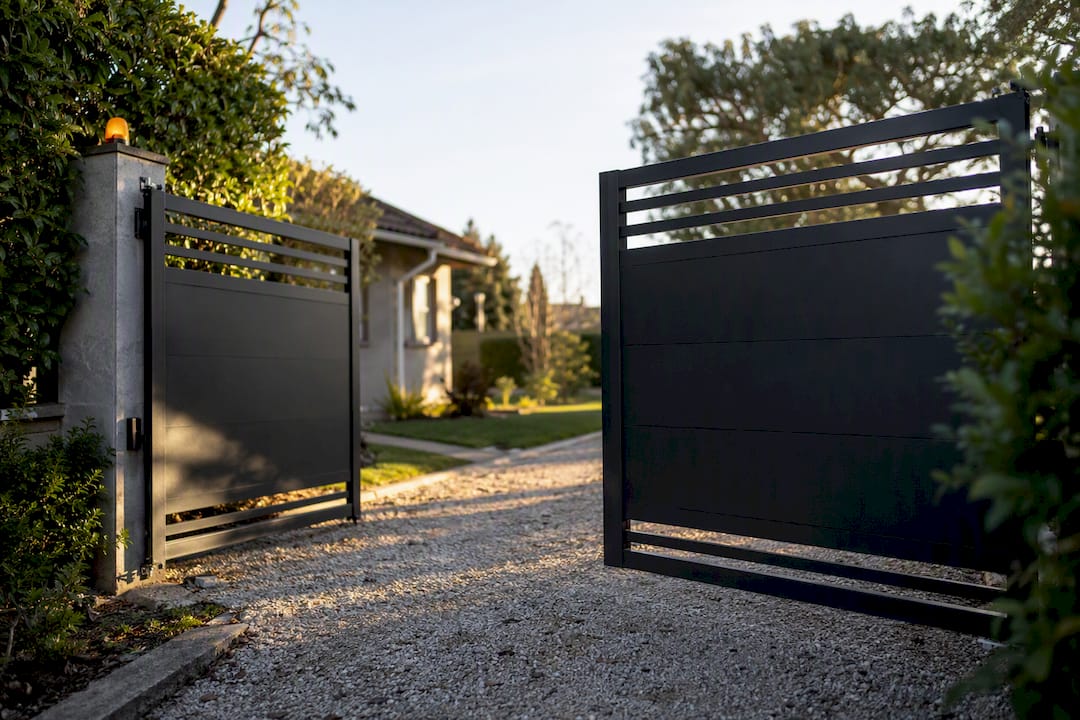
Swing gates pivot on hinges, either single or double leaf. They’re the cheapest to install and the most familiar look for residential driveways. The catch: they need clear swing space on one side, which rules them out for steep driveways or short setbacks. They work well with light-duty automation and suit occasional-use residential driveways better than high-cycle commercial entries.
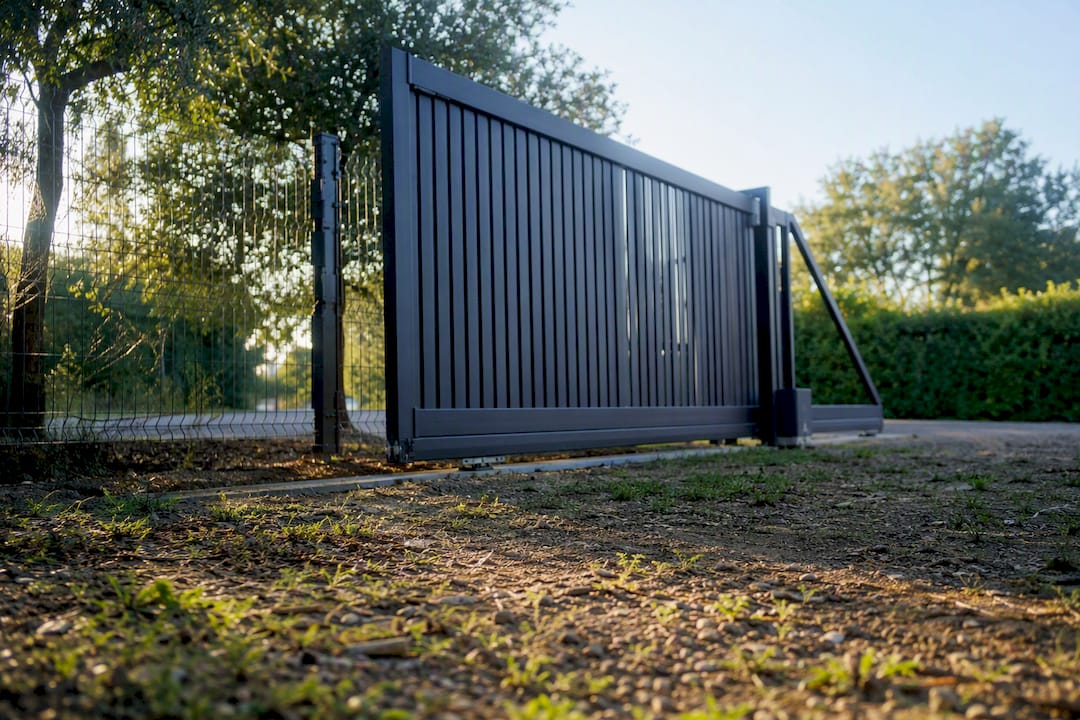
Sliding gates, including cantilever versions, roll horizontally along the fence line instead of swinging into the property. Cantilever sliders skip the ground track entirely, which matters a lot on unpaved surfaces, uneven grading, or anywhere leaves and debris would jam a track-mounted system, according to installation guidance from Access Professionals. Ground-track sliders cost less but need periodic track cleaning. Both need a straight run of fence line roughly equal to the gate’s width, which can be a dealbreaker on narrow lots.
Bi-folding gates fold in half as they open, cutting the space needed to under half the gate’s width. That makes them the standard choice for commercial lots and parking structures where cycle speed matters and you can’t spare a full swing radius. They cost more upfront and have more moving parts to maintain than a simple swing gate.
Vertical lift and pivot gates rise straight up or rotate on a vertical axis rather than swinging or sliding. These show up most often at industrial sites, self-storage facilities, and anywhere a full-width horizontal gate simply won’t fit. They demand overhead clearance and a heavier operator, but they’re extremely resistant to ram-raid attempts because there’s no track or hinge to force.
Rolling, overhead, and telescoping gates extend the sliding concept for wide openings, often stacking two or three panels that telescope past each other. Warehouses, distribution centers, and large commercial yards use these when a single-panel slider would need too much fence-line real estate.
Pedestrian gates and turnstiles handle foot traffic separately from vehicles, which cuts down on tailgating risk at high-security sites and speeds up entry when you don’t want people waiting behind a car for the main gate to cycle. Boom barriers, meanwhile, control vehicle access without blocking sightlines. Common at parking garages and gated communities that need fast, low-cost throughput control rather than a full physical barrier.
- Swing: needs clear arc, lowest cost, best for standard residential driveways
- Sliding/cantilever: no swing space, works on slopes, better for tight lots
- Bi-folding: fastest cycle, ideal for commercial high-traffic entries
- Vertical lift/pivot: max security, needs overhead clearance, industrial-grade
Pro Tip: If your driveway slopes toward the street, ask your installer about a cantilever slider before you commit to a swing gate. A sloped approach can make a swinging gate drag or bind within a year.
Which Materials And Ratings Actually Matter?
Steel remains the strongest structural choice for a security gate, and galvanized or powder-coated steel resists corrosion far better than bare steel left exposed to weather. Aluminum costs less to run because it’s lighter on the operator’s motor and naturally rust-resistant, though it won’t match steel for raw impact resistance. Wood and vinyl gates look great and suit HOA aesthetic rules, but they offer the least physical security of the common materials. Rolling steel shutters remain the go-to for storefronts that need serious after-hours protection.
Beyond the frame material, check the electronics. Outdoor keypads, intercoms, and card readers should carry an appropriate IP rating for weather exposure. Gate operators themselves should meet UL 325 safety standards, which cover obstruction sensors and required manual-release provisions. Some commercial specs reference SR (Security Rating) classifications for reinforced construction, though these apply mainly to specialty high-security installations rather than typical residential or light commercial jobs.
Finish matters more than most buyers expect. Coastal properties in particular should specify hot-dip galvanizing under a powder coat rather than powder coat alone, since salt air accelerates corrosion at any seam or scratch in a single-layer finish. Electric driveway gates with proper materials and power planning can even add a modest bump to property value, according to installer guidance on electric gate systems, on top of the security they provide.
- Steel: strongest, needs corrosion protection in wet climates
- Aluminum: lightweight, naturally rust-resistant, lower impact strength
- Wood/vinyl: best curb appeal, weakest physical security
- Rolling steel shutters: top-tier storefront security
Which Access Control System Fits Your Users?
Match the credential type to who’s actually using the gate. Employees and residents do well with fobs or mobile credentials for daily use. Visitors and delivery drivers need something temporary: a one-time PIN, a QR code, or an intercom call to a manager rather than a permanent credential someone forgets to revoke. Commercial properties with a mixed user base get the most value from cloud-based platforms that combine fob, mobile, PIN, and intercom access in one system, since they centralize permissions and cut the administrative burden of managing multiple standalone readers, per research on commercial gate entry systems.
Connectivity is its own decision. Wired connections are the most reliable option and carry no recurring fees, but trenching for conduit adds real installation cost. Cellular systems deploy fast with no trenching, though they carry a monthly plan. Wi-Fi is the cheapest to set up but the least dependable outdoors, where range and interference cause dropped connections, according to access-control installer guidance. Sites without easy power access should plan for solar or battery backup from day one.
On the protocol side, ask specifically for OSDP rather than legacy Wiegand wiring. OSDP encrypts communication with AES-128 and supports bidirectional supervision, so the system knows if a reader gets tampered with. Wiegand transmits data unencrypted, which makes it vulnerable to physical sniffing and card cloning on higher-security sites.
- Employees/residents: fob or mobile credential
- Visitors/delivery: temporary PIN, QR code, or intercom
- Mixed-use commercial: cloud platform combining all four
- Protocol: OSDP over Wiegand for any new install
Pro Tip: If your installer only quotes Wiegand readers, ask why. Most reputable vendors now default to OSDP and should be able to explain the tradeoff clearly.
How Do You Choose The Right Gate For Your Site?
Start with a tape measure, not a catalog. Getting these numbers right before you talk to an installer saves you from a redesign mid-project.
- Measure driveway width and turning radius for the largest vehicle that will regularly use the gate, including delivery trucks or emergency vehicles.
- Check slope and grade across the gate’s full path of travel, since even a mild incline can rule out a standard swing gate.
- Note overhead clearance if you’re considering a vertical lift gate, and confirm nearby utility lines won’t interfere.
- Count expected daily cycles and who’s opening the gate: residents only, or a rotating mix of staff, tenants, and visitors.
- Map emergency access needs, including how the gate behaves in a power outage.
Before signing anything, ask your installer these questions directly: Is the operator UL 325 compliant? What relay type does the control board use, and is it compatible with your access-control hardware? What’s the documented fail-safe or fail-secure behavior during a power outage? What’s the realistic maintenance schedule?
- Red flag: no clear answer on failure behavior during outages
- Red flag: vague or missing UL 325 documentation
- Red flag: no mention of obstruction sensors or manual release
A thorough site survey catches slope and clearance issues before they become expensive change orders.
What Do Security Gates Cost To Install?
Manual swing gates typically run cheapest, with automated versions costing more once you add an operator, sensors, and a keypad or intercom. Sliding and cantilever systems usually cost more than swing gates of the same width because the track and support structure take more material and labor. Bi-folding and vertical lift gates sit at the higher end, reflecting their heavier operators and more complex hardware, in line with the cost ranges reported by Angi’s guide to security gate types.
Budget beyond the gate itself for trenching and electrical work if you’re going wired, permit fees (which vary by municipality), and any monthly connectivity fee for a cellular access system. Timeline usually runs from an initial site survey through design, permitting, site prep, and final commissioning testing. Permit delays and underground utility surprises are the most common causes of schedule slippage.
- Manual swing/sliding: lowest cost tier
- Automated swing/sliding: mid-tier, adds operator and sensors
- Bi-folding/vertical lift: highest tier, heavier-duty hardware and controls
- Add-ons: trenching, permits, monthly connectivity fees
Keeping Your Gate Reliable Through Every Season
A short seasonal routine beats an expensive emergency repair. Lubricate hinges, rollers, and tracks at least twice a year, and clean debris out of any ground track before it jams the mechanism. Test obstruction sensors and manual-release function regularly, and check backup battery charge if your system relies on one during outages.
Outdoor electronics need an adequate IP rating for your climate, and coastal or high-humidity regions should specify galvanized steel under powder coat rather than a single-layer finish.
- Lubricate moving parts twice yearly
- Clean tracks and clear debris regularly
- Test sensors and manual release
- Check battery backup charge each season
Pro Tip: Schedule your spring maintenance check before pollen and debris season hits. A clogged track is the single most common cause of gate operator strain.
What Should A Professional Gate Quote Include?
A qualified contractor brings an accurate site survey, correctly sized operator selection based on gate weight and cycle frequency, permit assistance, and UL 325 compliance knowledge that a DIY install often misses.
A solid quote itemizes materials, names the operator model and its ratings, spells out trenching or electrical scope, states warranty terms, and includes commissioning tests before handoff. Advantage Fencing’s service offerings cover this full scope, from design through installation.
- Itemized materials and operator specs
- Trenching/electrical scope defined upfront
- Warranty terms in writing
- Commissioning test included before handoff
A contractor’s take on what actually goes wrong
The gate itself is rarely the problem. It’s the buried utility line nobody flagged, the slope that looked minor until the slider started dragging, or the permit that took three extra weeks. Prioritize a contractor who surveys thoroughly and plans for fail-safe behavior over one who just quotes the lowest price.
Getting Your Gate Project Started With Advantage Fencing
Advantage Fencing designs and installs custom gates matched to your property’s actual site conditions, not a generic catalog size. That means an on-site survey to measure clearance and slope, material selection suited to your climate and security needs, and access-control integration that fits how your property actually operates day to day.
A quote from Advantage Fencing includes itemized materials, the right operator for your gate’s size and cycle frequency, and clear guidance through permitting where required. Whether you need a residential swing gate, a commercial bi-folding entry, or an industrial-grade slider paired with a chain-link security fence, the process starts with a conversation about your site. Reach out through Advantage Fencing’s services page to schedule your site survey and get a detailed quote for your property.
Sources
- Types of Security Gates
- Electric Driveway Gates: 5% Value, Ultimate Security
- Gate Access Control Devices: Selecting the Right Readers, Keypads, Intercoms
- Commercial gate entry systems
- 5 Main Types of Security Gates for Homes & Businesses